Chapter C – Khorug, the Atomic Imam and the Wakan valley
So first of all, someone told me that I ended up with a little cliff hangar in the previous post, when I wrote that Khorug is a wonder city in my opinion. It is indeed, but maybe for reasons that you'll find less exciting than me. It is not miraculous because it is particularly beautiful (although there is an impressive view of mountains around), but simply from the thought that everything I see in the city, every item on the shelves of the grocery store, every brick used in a building, even the coffee machine that made the coffee I'm sipping right now while writing this lines (in one of the only two coffee shops in the city – *everything* came here on The horrible horrible road I cycled on for the last 4 days (before Qalai Khumb the road is actually paved). I have a curiosity in general around the topic of supply chains, It's something that always intrigues me. And when I saw the trucks that travel this bumpy narrow road, sometimes having to do a very complex dance to pass one another between the wall and the gorge (see previous post), I thought it was a quite a commitment to the existence of a city.
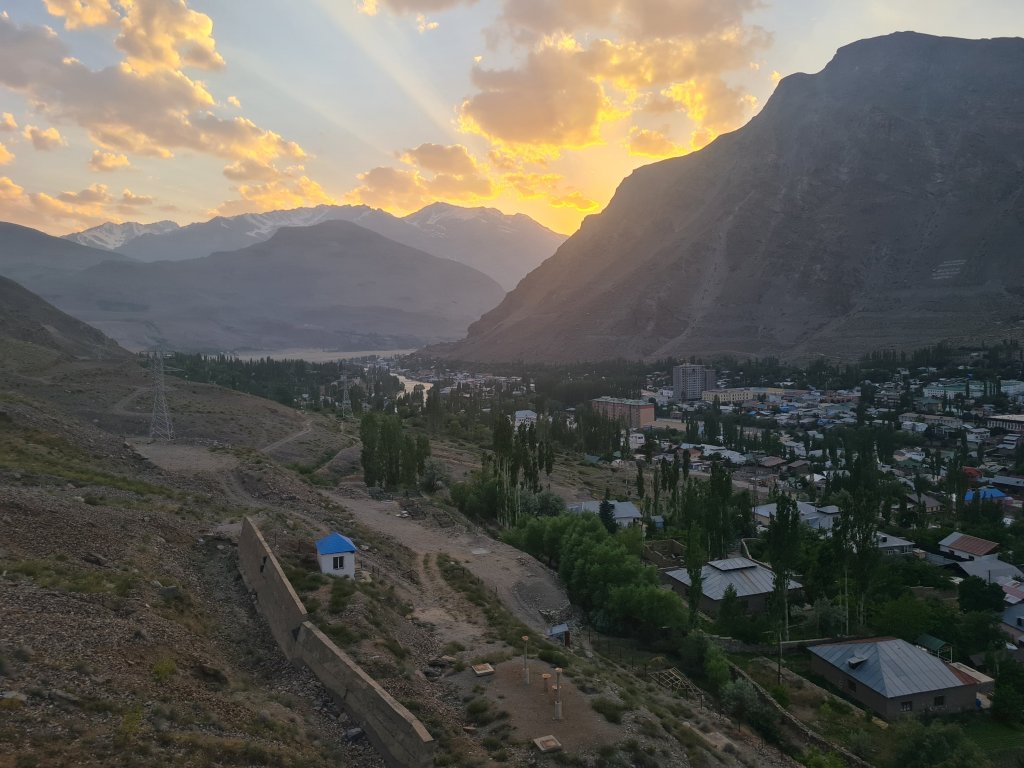
I stayed in Khorough for 5 days, much longer than expected (as usual), due to a combination of errands, bike problems (and a failed attempt to return the rear wheel's tubelessness that I stupidly lost in Samarkand), a slight upset stomach, personal logistics that I had to take care of, and just a general waste of time. One of the errands I had to make required a real computer, which led me to visit the library of a branch of a university established by the Aga Khan Foundation (or AKF for short), which I already mentioned when I talked about the electrification project in the Panj Valley, and I think it's time to talk about his Highness, Aga Khan the 4th.
The Atomic Imam
Another thing that distinguishes the Pamirs from the rest of Tajikistan, beyond language and ethnic affiliation, is the issue of religion. While most Tajiks, and muslims in Central Asia generally, are Sunni Muslims, the inhabitants of the Pamirs are Shiites, and not just any Shiites. The Pamiris mostly belong to the Naziri-Ismaili sect, which is considered the second largest Shiite stream in Islam, with 15 million believers worldwide, and seems to me to be one of the more interesting of the bunch.
The Ismailis split from the main Shiite sect (which is of course a split from the "mainstream" islam as well) in about 1000 AD, which made them hated by both the Shiites and the Sunnis. They ran a small country in the mountains of Iran, and since they were a small minority, persecuted and surrounded by enemies – Shiite, sunnis, christians – they mainly resorted to guerilla/terrorist tactics, the most famous of which was the assassination of leaders of hostile factions*, and their infamous order of assassins, called the Hashishion, which is the source of the English word assasain. The well-known story, that they drugged their assassins with hashish so that they would not be afraid to sacrifice themselves, hence the name Hashishion, is generally considered today an urban legend invented by Western visitors who did not quite know how to digest the phenomenon (I'm looking at you, Marco Polo), But I couldn't exactly understand what *is* the origin of their name (read some different explenations, from a derogatory term in islam used by thier enemies, to the word "principal/main" in arabic, becasue they targeted prinicipal leaders). But it is true that it is the origin of the word "assasain" came from that order of Hashishion. Etymology is sometime a complicated thing.
In any case, in the 13th century the Mongols came, and as they did to many other nations in their path, with a combination of diplomacy, Intrigue and extreme violence, they captured the Nizari state and pretty much scatter the Nizari people them to the wind (that is, those they didn't murder outright). The Ismailis have spread all over the world but kept faith to their Nizari religion, and especially to their spiritual leader, the Imam-i-Zaman ("the imam of our time"). And this imam is important. Because what makes the Ismailis unique is that, for them, their imam is a direct descendant of Muhammad (via Ali, the founder of the Shia movement), which makes the islamic imams a kind of a papacy on a spiritual level, but also a royal family on a practical level, since it's a heredetory title. And beyond this heredetiry feature, the current imams are actually descendants of a royal/noble Iranian dynasty, and hold the title "prince", so they are royalty even in secular terms. Since the middle of the 19th century, the Ismaili imams have been called the "Aga Khan", a title of honor they received during the British rule in India, and today they are led by the fourth Aga Khan, Prince Karim Al Husseini, on whom I would like to dwell a little more.
Now, when you are told "the imam of an important Shiite sect", I don't know what you imagine, and maybe my imagination is limited and biased a bit, but I imagine some sheikh wearing long robes, or someone like, let's say, the first Aga Khan –
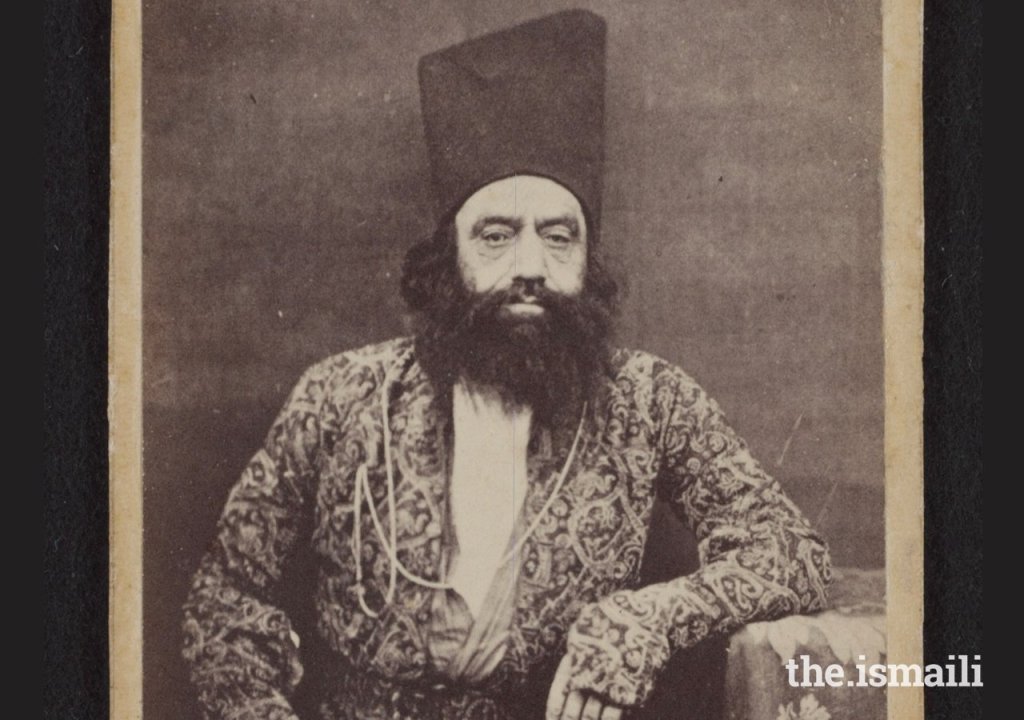
But the current Aga Khan, well, looks a little different from that stereotype. This is, for example, a picture of Prince Karim from his 20s. Handsome!
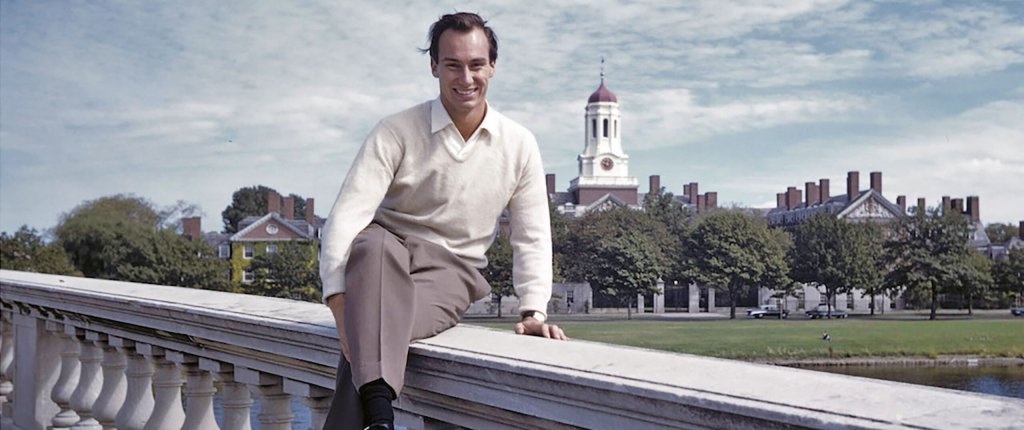
From the outside, the Aga Khans can be seen as European royal family without an actual kingdom, but they are also much more than that. The Aga Khan dynasty began to integrate into the West in the last hundred years, both on a cultural and a family level – the mother of the Aga Khan IV is British and hisgrandmother, the wife of the Aga Khan III, is Italian. He himself was married to a British model and then to a German businesswoman (and divorced both). He was actually in the middle of his undergrad degree at Harvard when he received the news that he was going to be the next Nizari imam, in 1957, in his early 20s. Why so early? Because the Aga Khan III was not his father, but his grandfather, who decided in a very unusual way that the Aga Khanite title is going to skip a generation. Not because he thought that his son is incompetent (or at least he didn't say so publicly), but because according to him, With all the changes that are happening in the atomic age they are entering, it is important that the next leader of the Islamic community be a young person who can adapt to all these changes. This is why the Aga Khan IV got the the nickname "the atomic age imam". And adapt he did.
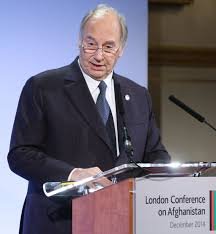
The Ismaeli-Nizarite community, which as mentioned is scattered around the world – in Africa, Asia and North America – has gone through quite a few crises in the last half century, and the Aga khan was the one to try and sort them out. Just as an example, when Idi Amin decided to deport all Asians from Uganda, including the Ismaili community, and gave them 72 hours to leave the country, the Aga Khan picked up the phone to his friend, Prime Minister of Canada at the time Pierre Trudeau, and arranged for several thousand Ismaili-Naziri to immigrate to Canada on a short notice. in a nutshell, he is one of the most well-connected (and richest) aristocracy/royalty in the world. He hold personally quite a lot of wealth, which is estimated in the hundreds of millions (he owns a yacht, he breeds and sales racehorses, etc. they are, after all, a kind of thousand-year-old royal family), and in general was considered a bit of a playboy at the time. But most of his power and influence comes from the Aga Khan Development Network, or AKDN for short, which he heads. The AKDN is a network of for-profit and non-profit organizations that manage financial and philanthropic projects all over the world. Their financial base is the donations and tithes that every member of the Ismaili community contributes, so while the aga khans might be a royal family without a kingdom, they are certainly not without a tax-base, so to speak. Since the Ismaeli community is scattered around the world, there are those who can give less and there are those (say, those who now live in Canada) who can give more. and probably more than enough – the AKDN has an annual budget of hundreds of millions of dollars that go to promote projects throughout the developing world. by the way, most of them are in areas with an Ismaeli community (like the Pamirs) but some of them are purely philanthropic, in areas that has no Ismaelis at all. anyway, In Central Asia, as mentioned, they connected people to electricity in the Pamirs, established the Central Asia University with branches in Khorog, Kyrgyzstan and Kazakhstan, and established a number of schools in small villages in the Pamirs. I (and several other travellers) noticed that although Pamir is quite a remote area, the average level of English there is higher than the rest of Tajikistan. At first I thought it was related to the rise of tourism in the area, but an English teacher in a small village in Bartang told me that in his opinion, it is directly related to the investment of the AKDN (or in this specific case, the Aga Khan Foundation, which is the branch of the AKDN that's in charge of the philanthropic activity, and that's the name and symbol you'll see everywhere in the Pamir).
I saw a profile article of the Aga Khan that said that more than a spiritual leader, he's actually sort of the CEO of the Ismaelic religion, and when you look at this older Brit in a suit and tie (he's a British citizen, of course), that seems a pretty accurate description.
And as CEO of the Ismaelic religion, he had some difficult decisions to make in the early nineties in the pamirs, and we'll get to that in the next section.
The Wakan Valley
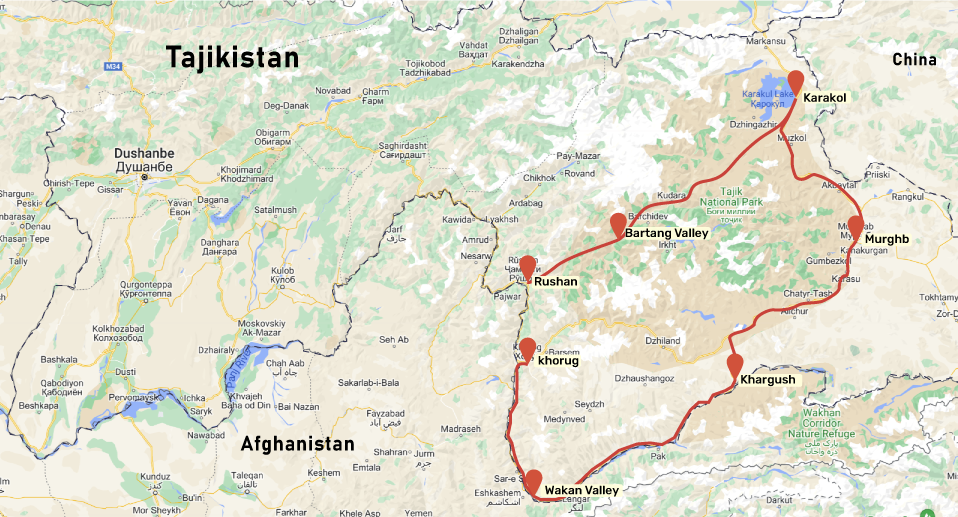
While I took care of my errands, Pia and Baldur moved on. I was supposed to continue with Tanya and Joss, a couple of nice swiss cyclists, who actually passed through Israel on their trip, where their expensive bikes were stolen (goddamn you, Tel Aviv), but then the Israeli cycling community rallied and bought them new bikes, because that's what Israelis do sometimes. For my part, I used them to get the me very specific spokes i needed for my bike, in my own complicated supply chain. But on the morning we were supposed to set off, some problem with my bike delayed me, and by the time I was ready, it was already noon and they had disappeared far away, so I set out alone for the Wakan Valley.
The Wakan Valley is in a sense the Pamir of the Pamirs – if the Pamirs have a separate language and culture from the rest of Tajikistan, the Wakans have a separate language and culture from the rest of the Pamirs. The last villages before the Khargosh pass at the end of the valley are really as remote as you can get (but you can still find some food in the grocery store there!). The valley sits between the Pamirs the Indus – Kush mountains range, and every now and then a stunning snowy peak peeks out from among the small valleys the feeds into it.
Bottom line, this is a spectacular and exciting place, that I didn't enjoy that much.
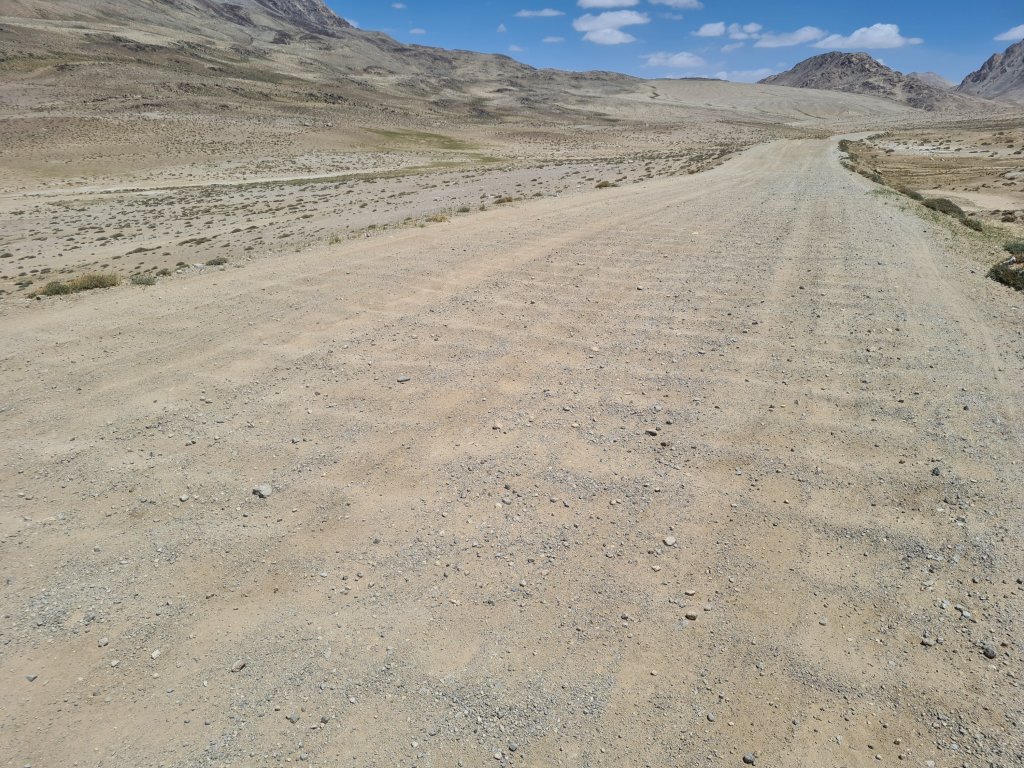
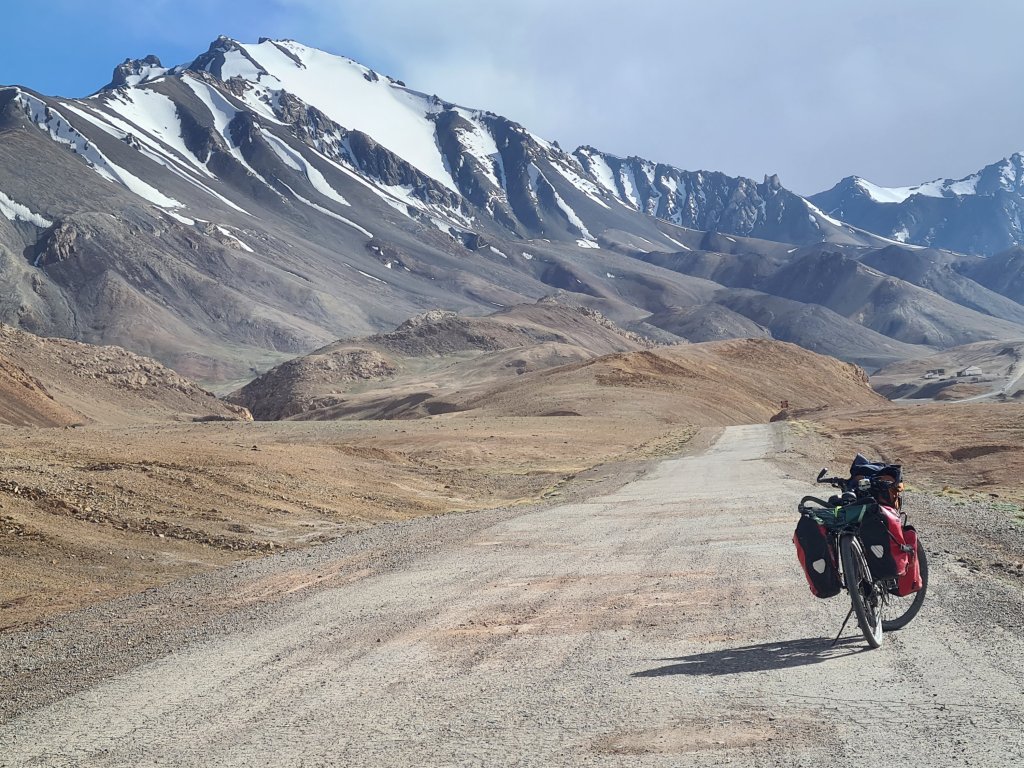
First of all, the first two days were spent again in a cloud of sand, although not as serious as the one I experienced at the beginning of the journey, but still the view was significantly faded and dimed. In the following two days, after a serious storm, things cleared up a bit, but then the road turned from asphalt with potholes (which for bikes is actually an advantage – potholes don't bother us, but cars drive slower. (not that there were many of those in Wakan)) to a heavily washboard/corrugated dirt road , which is the worst kind of road possible for a bike. It's something that breaks the morale even more than a headwind (and I actually experienced mostly a tailwinds in Wakan). With a headwind, if you accept the fact that you're now going to ride at 8 km/h on a flat road and that's what it is, you can still get into a groove of riding and thinking. You're just on a very long climb that you can't see. In washboard, on the other hand, there's no way to zone out – it just hurts your hands and ass, rumbles your body and most of all breaks any momentum you are trying to build up, and makes everything feel like a constant struggle. I hate washboard with all my heart.
And most of all, I just wasn't at a good place, inwards. As I sometimes write here , I'm not on a long holiday, I just moved to live my life on the road for a while. And sometimes, in life, you get into loops inside your head, and you don't always manage to break out of them, especially when you're by yourself. that's the time when the presence of other people can help. As someone put it eloquently, when you're at a low point, the solution is not a hut in the woods (it's long, but worth a listen) The reasons for the mental loops are sometimes prosaic and stupid in retrospect, and sometimes are more substential. but in the moment, most things seems substential (and when they don't, you can always beat yourself up for being sad about stupid things and be depressed about being depressed. thanks, mind).
It wasn't all suffering, far from it. There were great moments, like visiting a tiny museum of Wakan culture and getting a demonstration of traditional musical instruments , or bathing in a hot spring on the side of the road, or an ice cream truck driver (to be clear, i mean a refrigerated truck that transports ice creams to grocery stores, not an "ice cream truck" with music and all) who stopped to ask if everything is okay, then pulled out two ice creams from the truck and gave me (people are really good, for the most part). There were also laugh-out-loud moments, like passing by a base of the Tajik army and catching the soldiers there in the middle of a party at the end of their tour, just before they return home (watch this, it's hilarious). In the Tajik army, which, like the Israeli army, also works in a model of a slave arm- eh, i mean, mandatory conscription army model, but unlike the Israeli army, they are not playing around when it comes to duty tours – a tour in the Pamirs means two consecutive months in a base at the end of the world without seeing home at all (oh, but the views!). so I could definitely understand the joy.
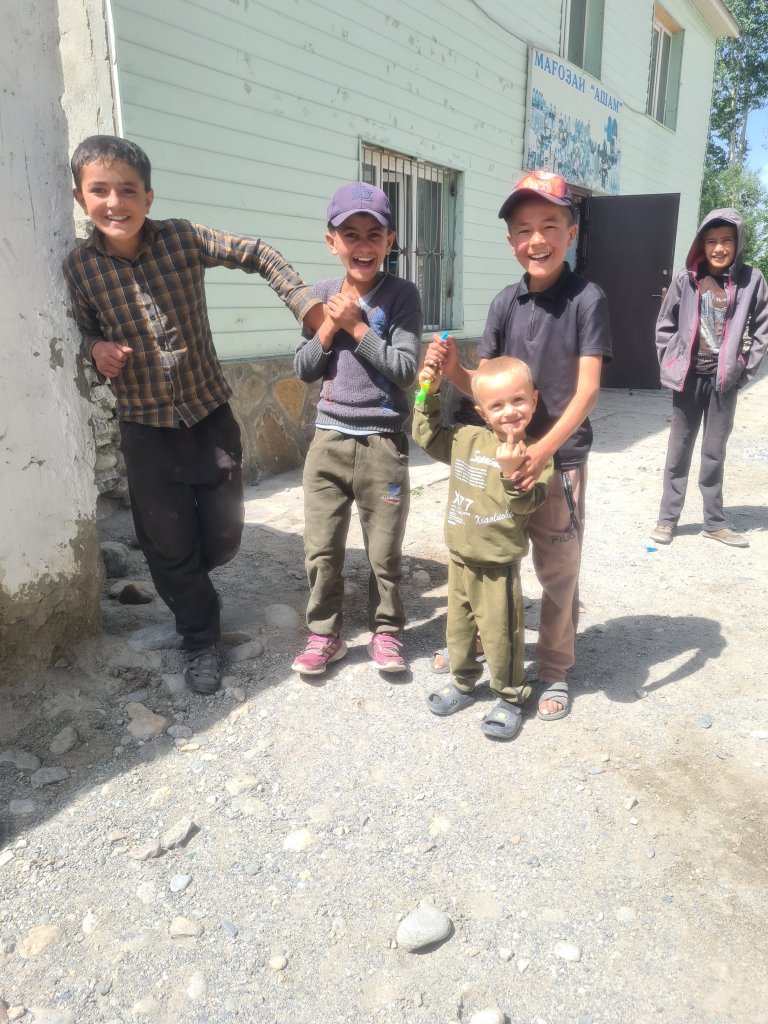
Ah, and getting the triple finger from a three-year-old blond Tajik boy in the middle of nowhere is also pretty comical.
And of course, the views, no matter what mood you're in, were objectively sublime.
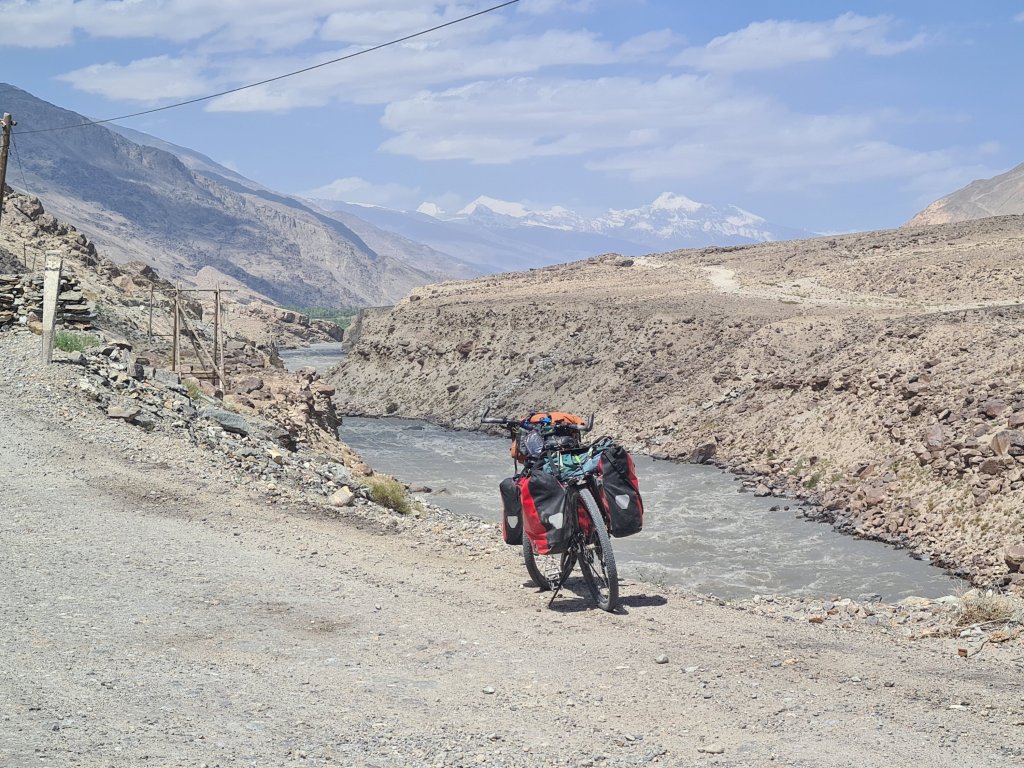
And yet, I'd be lying if I didn't say I was really happy when, at noon on the fourth day, after sitting down to lunch by the river, John and Finn suddenly appeared behind me
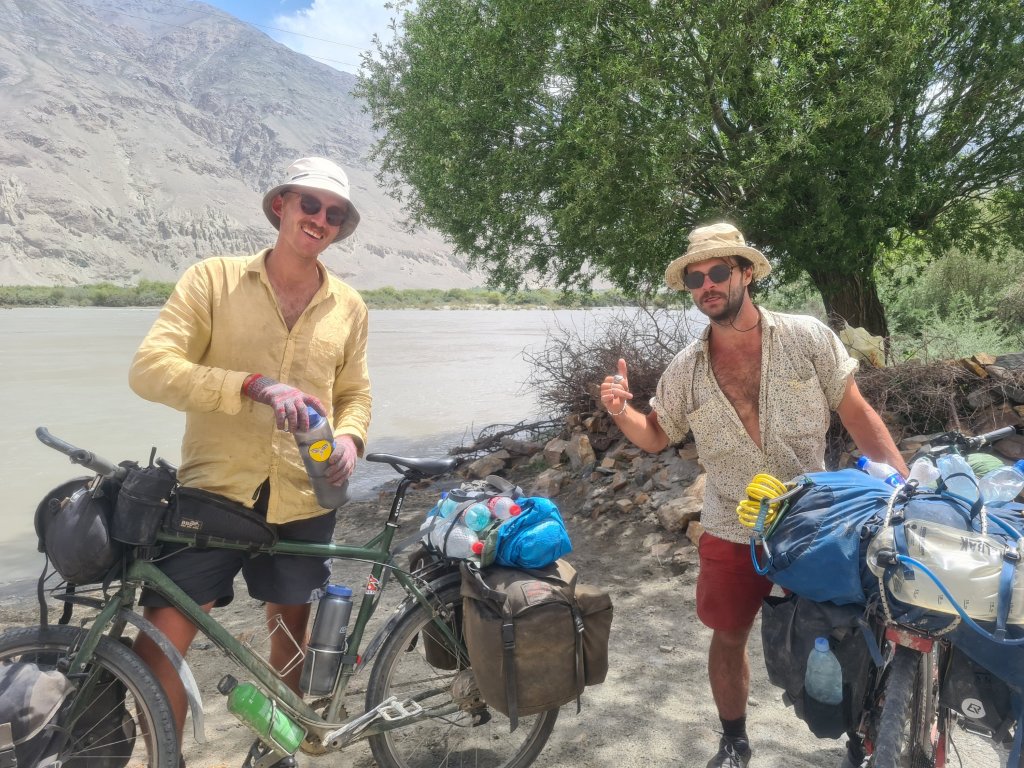
John is a 28-year-old American who I had a beer with back in Samarkand, one of the funniest people I met on the trip, who has been kind of traveling the world for three years (traveled in Africa and then went to New Zealand and got "stuck" there with Corona). Finn is an awesome 26-year-old Australian guy with a very impressive touring record, who I met semi-randomly already in Tashkent, and who somehow turned out to be the guy I spent the most times with in Central Asia, a fact i can hardly complain about. He rides much faster than I do, but stops every now and then to write papers for his geography degree, which he does while travelling (sounds like a dream, but there's obviously also downsides to that). The combination of the two made for one of the funniest groups I've ever ridden with, even if between John's Chicago accent and Finn's Australian accent I sometimes had a hard time following the conversation. I had trouble following them sometimes physically – both of them were significantly faster riders than me*. They were still in Khoroug when I set off, and I hoped they would catch up with me, and it eventually happened. It's almost embarrassing to admit that at that moment, the bike suddenly felt lighter.
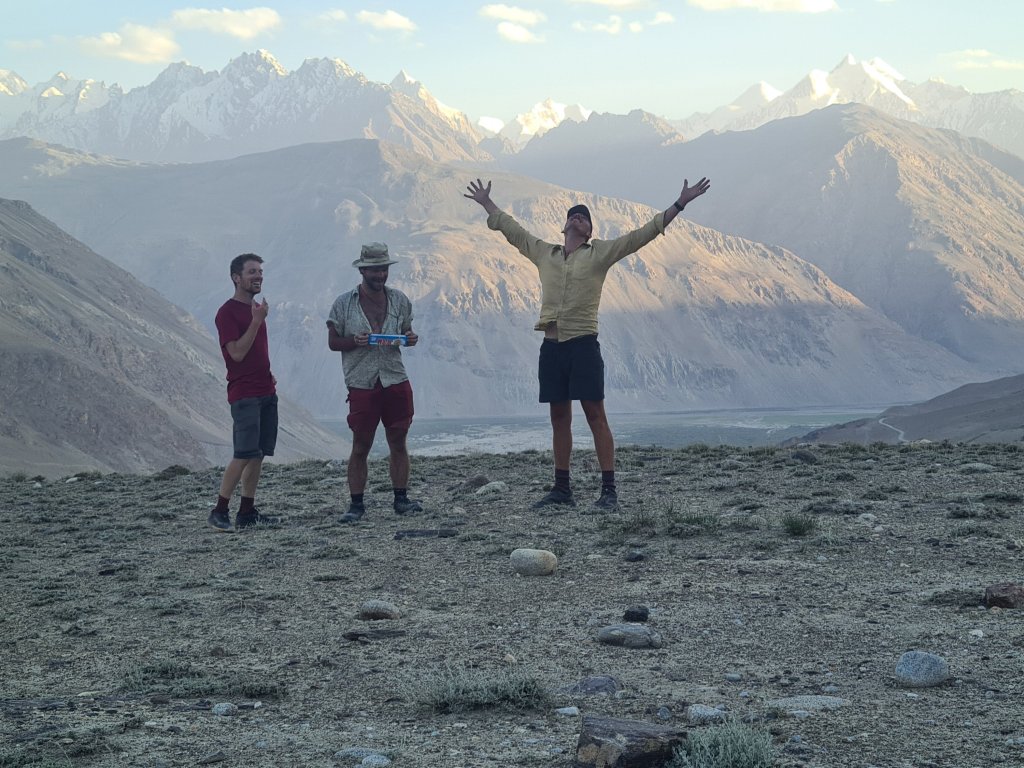
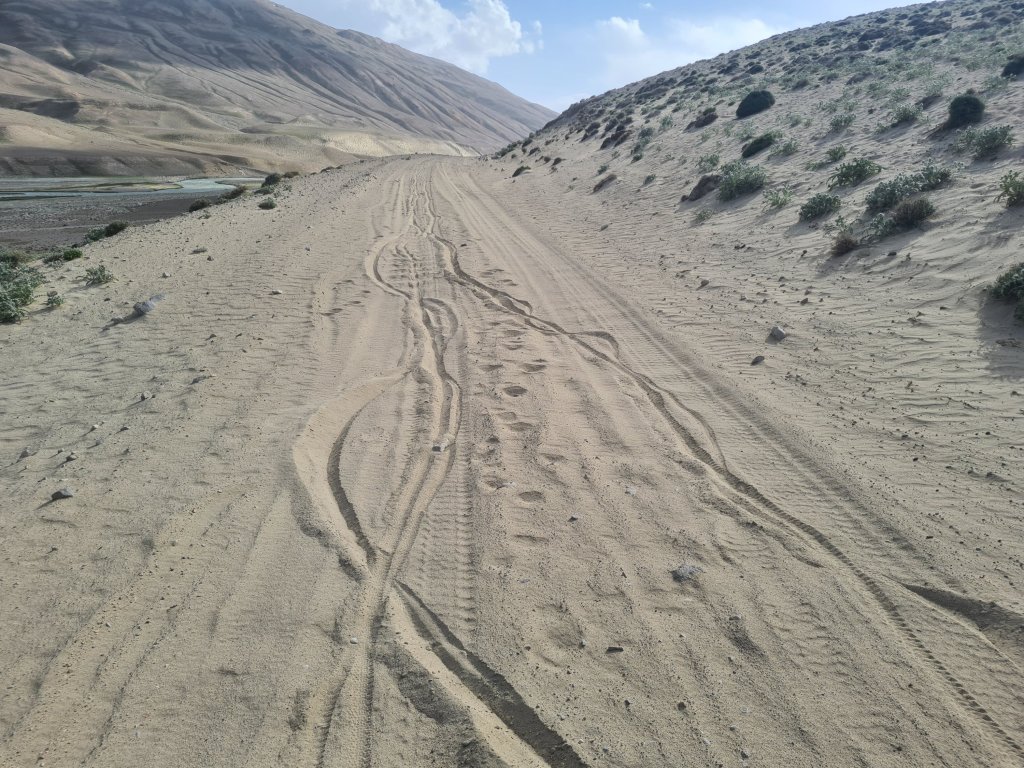
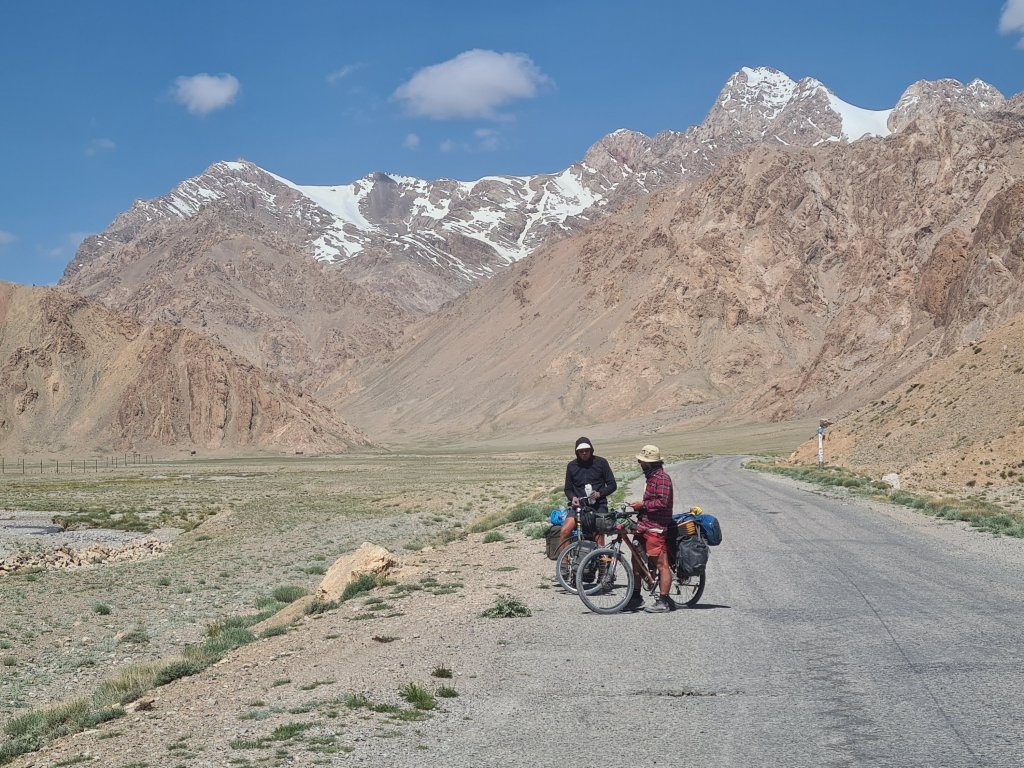
And it's a good thing we met up when we did, because it was just before the most challenging part of my adventure in the Pamirs – the Kargosh Pass, which connects the Wakan Valley back to the Pamir Highway (AKA M41). The Bartang Valley is considered the most difficult part of the loop for some reason, but i can say that the combined two days (afternoon + full day + another half day) of the climb to Pass were among the hardest rides I've done – dirt roads with improbable gradients, washboards in the flatter parts, occasionally sandy parts you sink, and oh yes – the air was getting thinner. We started the climb from the last village in Wakan at 2827 meters, and the pass itself is at 4344. It was again the highest pass I've ever done on a bike, but it's a record that Kargosh's pass will hold even less time than the pass of Tavildara. It was a tough climb, partly because I tried my best not to lag too far behind. Luckily there are podcasts and audiobooks in the world, and good company is very valuable at these moments.
We finished the end of the full day of the climb at the base of the Tajik army, where the soldiers run a small gig and host travelers in a small room for a reasonable amount. Since we were only a little below 4000 meters, a closed and warm room seemed to be an excellent idea. Next morning it momentarily felt like a less than great idea when a small earthquake (4.5 on the Richter scale, but we were right at the epicenter) rumbled the shack and we ran outside, somewhat shaken. It was also the morning that I lost my trusty flashlight to the Tajik army, may he rest in peace.
The last ascent to the pass was tough, partly because of an abandoned puppy who ran after me for miles and howled for me to take him with me. It kind of broke my heart. The descent from the pass was also not fun at all, because, well, we got a washboard for lunch as well. this is a video of me coming back to a paved road , and I promise that it is an authentic recording of my feelings. God, I never thought I would be so happy to see asphalt.
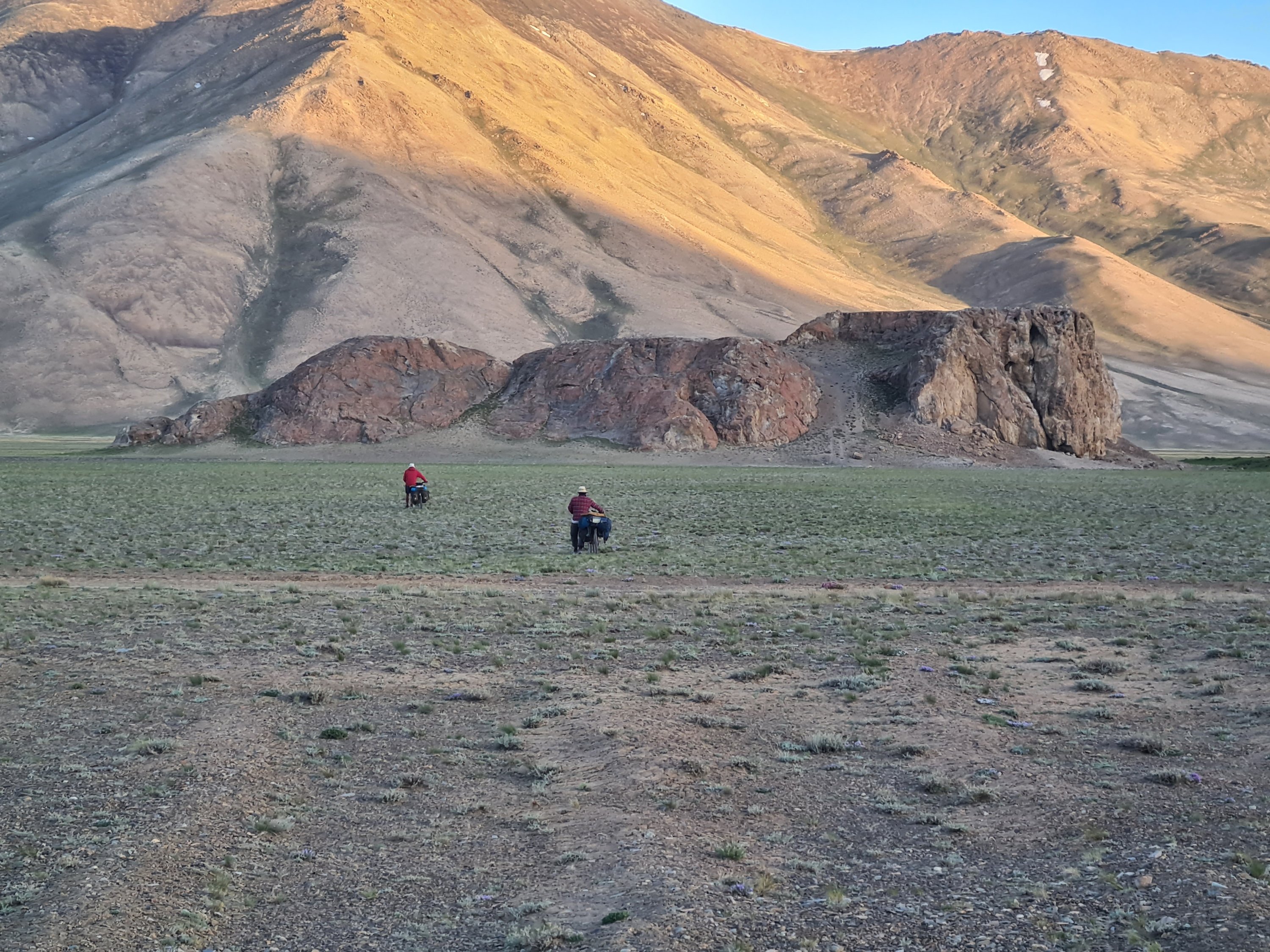
But after that we rode the rest of the day with a wonderful tailwind, on an almost deserted paved road between the arid plains and the mountain ranges, and now there was no doubt – we are deep in the Pamirs. it was a bliss of an afternoon.
*Side note – I got to say it's a bit challenging to be the slowest rider in the group, something I experience frequently when riding with other people. What I discovered about myself is that no matter how fit I am, I don't ride fast. I might be able to keep up with riding for longer distances than I could at the beginning, but I have a natural pace, and it's not very fast. I was slower than Ian in New Zealand, and slower than the group I rode with from Khiva, and Pia and Baldur, and now John and Finn (John specifically is unreasonably fast, especially for his shitty bike). And, honestly, it puts a bit of pressure on the riding experience. First and foremost, because you don't want to delay the group too much. It also means that your breaks are shorter (although I don't need long breaks), and moreover, you don't exactly have control over *where* the breaks are made. If you didn't coordinate it in advance – you just keep going until you get to where the front rider decided to stop. You can say fuck it and stop wherever you like by yourself, but then they will wonder where you are, and also what's the point of riding in a group if you eat lunch alone. on the other hand, i do need to stress that none of the people i rode with ever said anything about my pace, the pressure was always coming from the inside of my head.
Part D – Murghav, the broken valley and the things below the surface
From the connection to the M41 we rode to Murghav for a day and a half. John, during that, time managed to blow a tire and break two more spokes in his wheel (one was already broken) and still arrive safely. Every time I was unhappy with something on my bike, I only had to look at the rickety rig John was riding on and realize that my stead was reliable and stable.
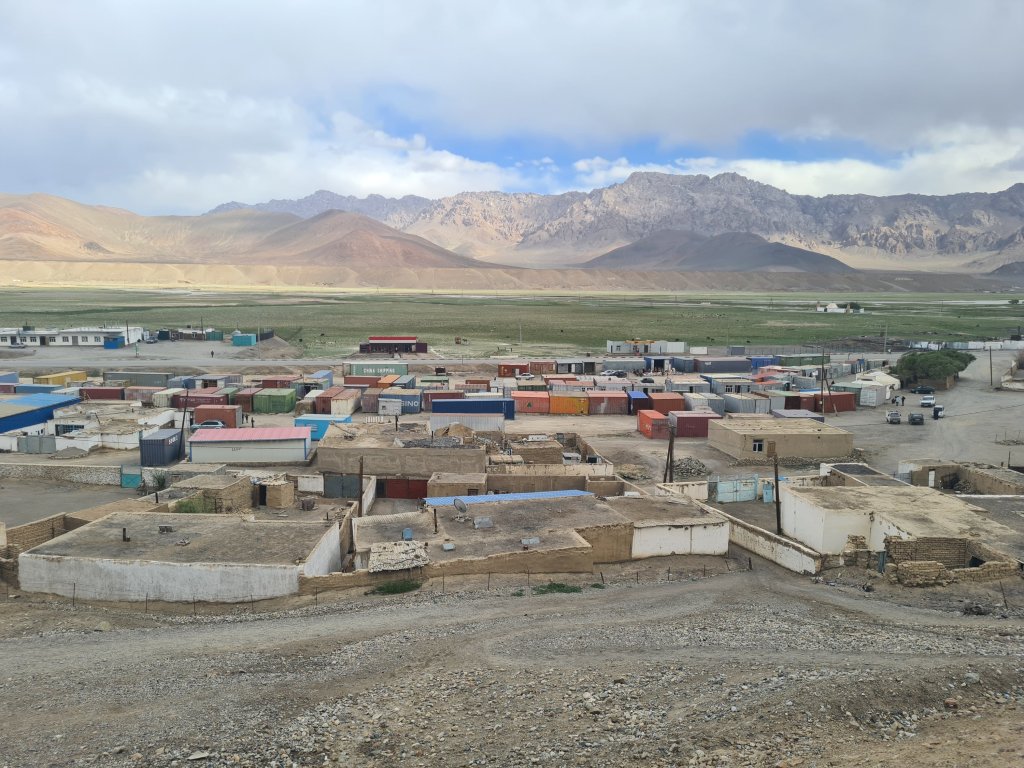
Murghav is a small town that, unlike Khorug, let's say, really feels… remote. There's something so remote there that it's hard to describe. I've been in places more distant from civilization, after all, the main road to China passes there, and still, precisely because it's a town, it felt at the end of the world (That is, until I got to Karakol, which redefined remoteness again). Anyway, I liked the market the most in Murghav, which was simply containers placed semi-randomly along "streets", and each container had a different shop. And I got to know this market quite well, because we stayed two nights in Murghav, and I unexpectedly had quite a few errands. Apart from the fact that I had to buy enough food for two days until Karakol and then for six days in Bartang (I was warned in advance not to count on the store in Karakol, although in retrospect pasta and onions could be found there, which was the main weight), during the ride from Khorug to Murghav my headphones, power bank and keyboard died, and I lost a headlamp to the Tajik army , so had to find replacements. Ah, find somewhere to change 100 dollars to somoni, Because there are no ATMs there, and it turns out that I didn't bring enough cash. Oh, and get a permit for the national park, and find where my mattress is leaking air (it's wasn't) and so on. And so it turned out that instead of a normal rest day, I did a day of running and logistics. I think this is the place to point out that it's hard for me to explain how huge and subsential part of this trip is logistics of one kind or another, and how much I hate it. I suspect it's not like that for everyone, because other people are more focused on these things, and also lose less stuff
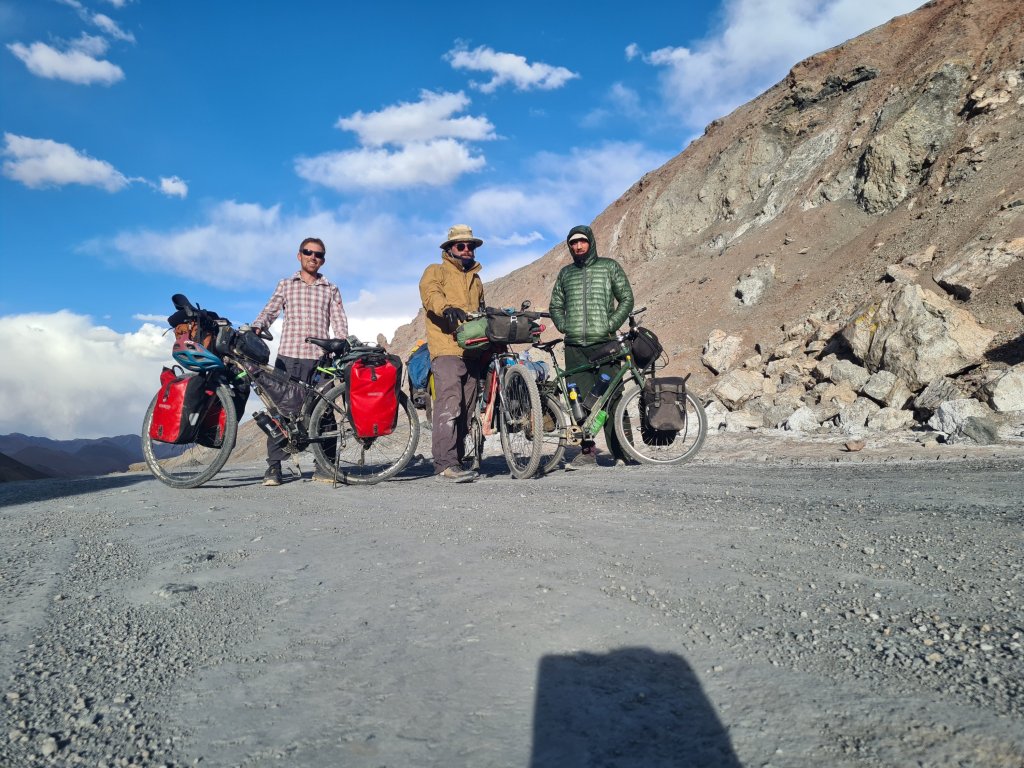
The next day we set off again, and after a long day of riding, we crossed the Ak-Baital, the highest pass I've crossed by bike for the third time this month – 4655 meters. But since it's the highest pass in the Pamirs, it's likely that it's going to hold that title for a long time, Definitely for this trip. Most of the ascent was not terrible, though i did have to fight against a constant headwind, but was amused by startled marmots occasionally. However, the last three kilometers were steep and quite a tough slugfest, and certainly in thin air and headwind. oh, and yes, the fact i was carrying food for 5-8 days was certainly felt. No amount of readily-available sugars could sweeten this climb, but I decided to try anyway (I recently discovered how good lollipops are for morale while climbing). Eventually I arrived, and in a very cute gesture on their part, Finn and John were waiting for me at the top of the pass, shivering with cold, even though they had been there a long time ago. When I told them first not to wait for me at the top of the pass, because it would be cold there, John said he was offended that I even suggested it, We need to make a picture of The Boys* in pass. So we did take a quick picture, and you can clearly see in the picture who reached the top of the pass two minutes ago and whose ass froze there for half an hour.
The next day we arrived in Karakol. Karakol is the last village before the Kyrgyz border. When the border is open, it's a reasonable stopover for trucks and travellers on the way to osh, on the other side of the border, but when the border is closed like it is now, it's literally the end of the world- so so far from anything. It's a small village, a few dozen families, houses that seem to be scattered randomly on the shore of the lake, and far on the horizon Peak Lenin, one of the highest mountains in the Pamirs, rises high above the lake. John, Finn and I spent the night in a Kyrgyz family's homestay (Karakol is an ethnically Kyrgyz village that found itself on the Tajik side of the border. It's very easy to recognize Kyrgyz people, with their cool white top hats) and spent a long funny evening playing an intense board game. The next day was time to for the group to split up, each going his own way – Finn had to get back in reception to submit some uni paper that was due, so he intended to ride the bartang immediately (and fast). John was determined to try to cross the closed border into Kyrgyzstan – there were rumors of people who managed to convince the guards to let them through (and he actually made it through! almost died in the process, but that's a differnet story). I personally felt that I still needed some kind of rest day that wasn't logistics, so I spent it sitting on the lake in Karakol, enjoying the silence at the end of the world, and writing a bit. And so it turned out that for Bartang, I went out alone again, but this time by choice. It was a lot of fun riding with John and Finn, but I was also happy to be back riding by myself, at my own pace, especially in Bartang, for which the best advice i got was- take your time.
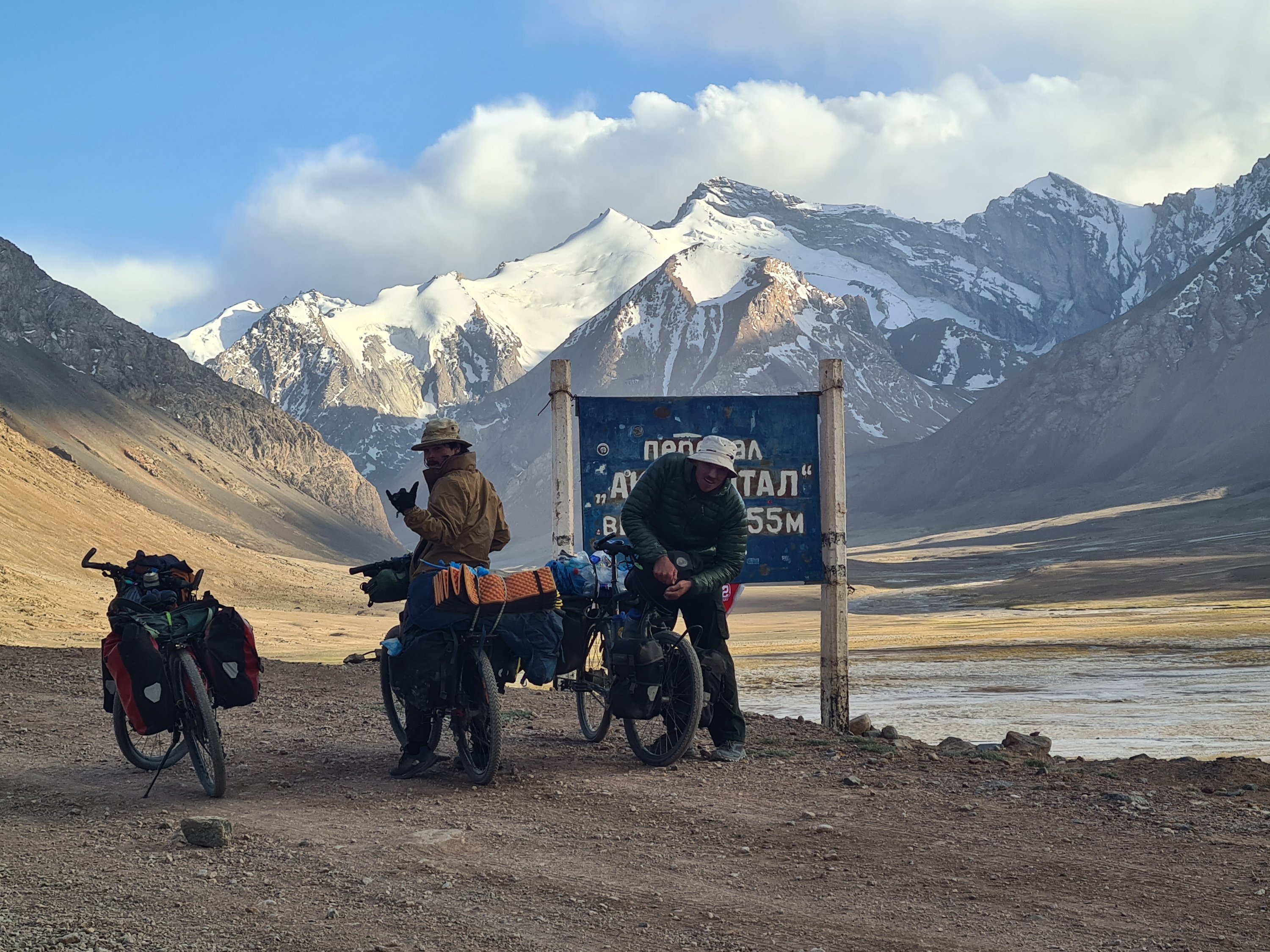
* "The Boys" was some recurring joke on our ride, which I can try to explain, but it wouldn't be so funny out of context.
Crossing the broken valley
Pretty early on i nicknamed the Bartang in my mind as "the broken valley", because you can see with your eyes all the way how the geography is still being formed there in a series of rockslides. On the second evening, while camping, I actually heard the rocks falling down the scree fall every once in a while in the cliff face behind me and in fact, two weeks after I left, the talk in the great vine(i.e. the whatsapp group) was that it was closed to passing "traffic" due to another landslide. but it's not just the topography, it's the roads that are very very broken, which is one of the reason it's important to not rush it and plan for 50-60 days max- even though you're going down the valley, you're going down slow, shaken by rocky roads. the other reason was that it was gorgeous.
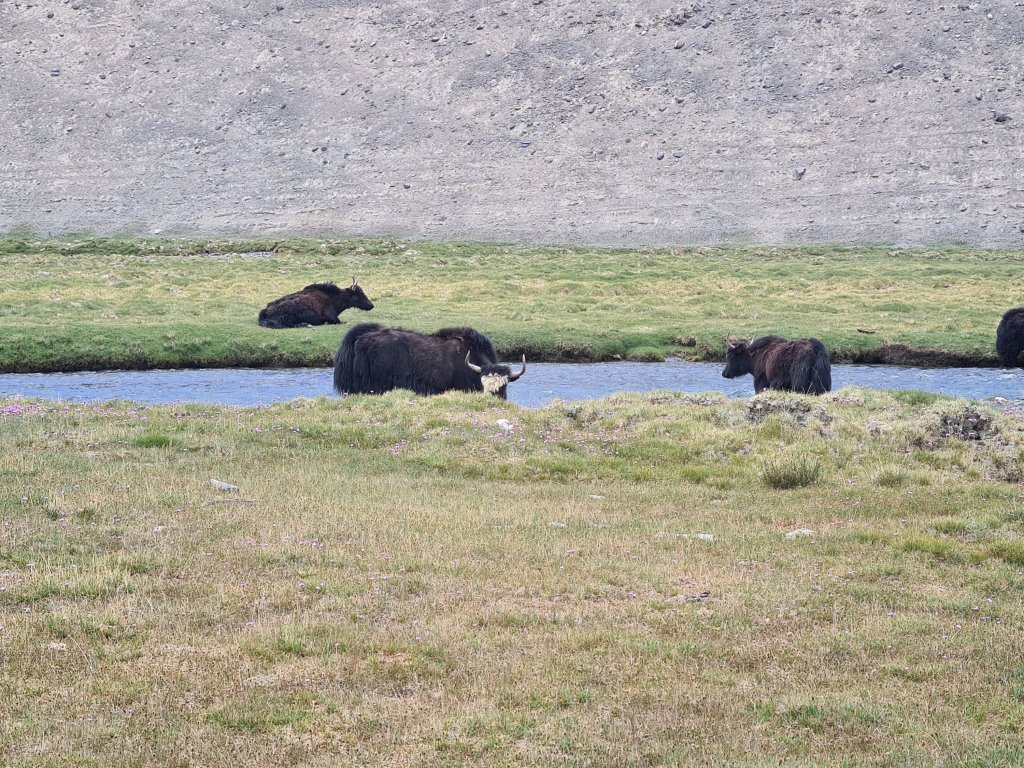
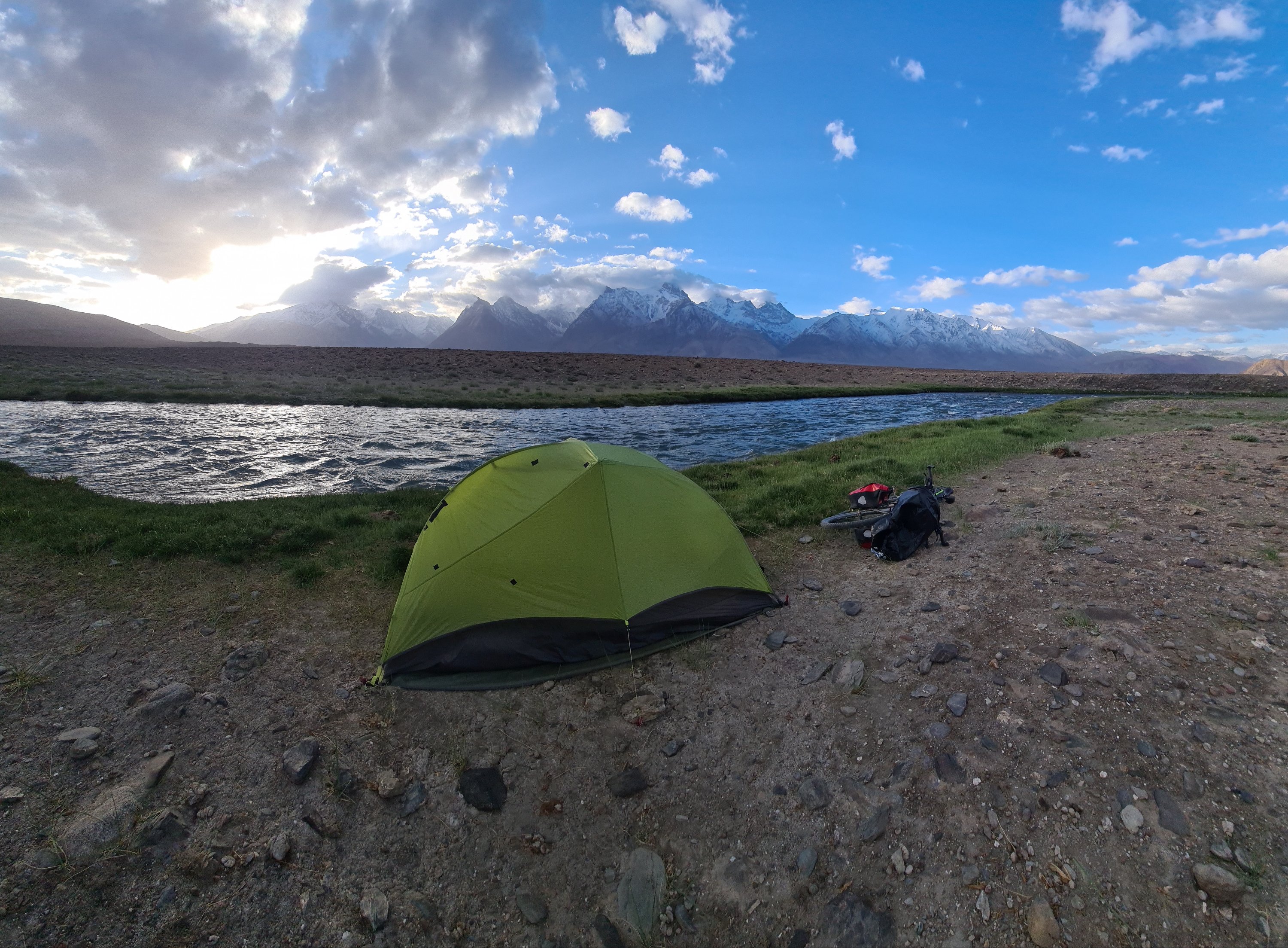
It takes about a day and a half to get to Bartang valley itself from Karakol, through the highands and a small tributary. During that day and a half I managed to catch a short but decisive graupel storm but also enjoy a wonderful tailwind, get bogged a bit in some sands, see actual herds of yaks and camp in front of one of the most spectacular views I've been privilage to set up camp in front of.
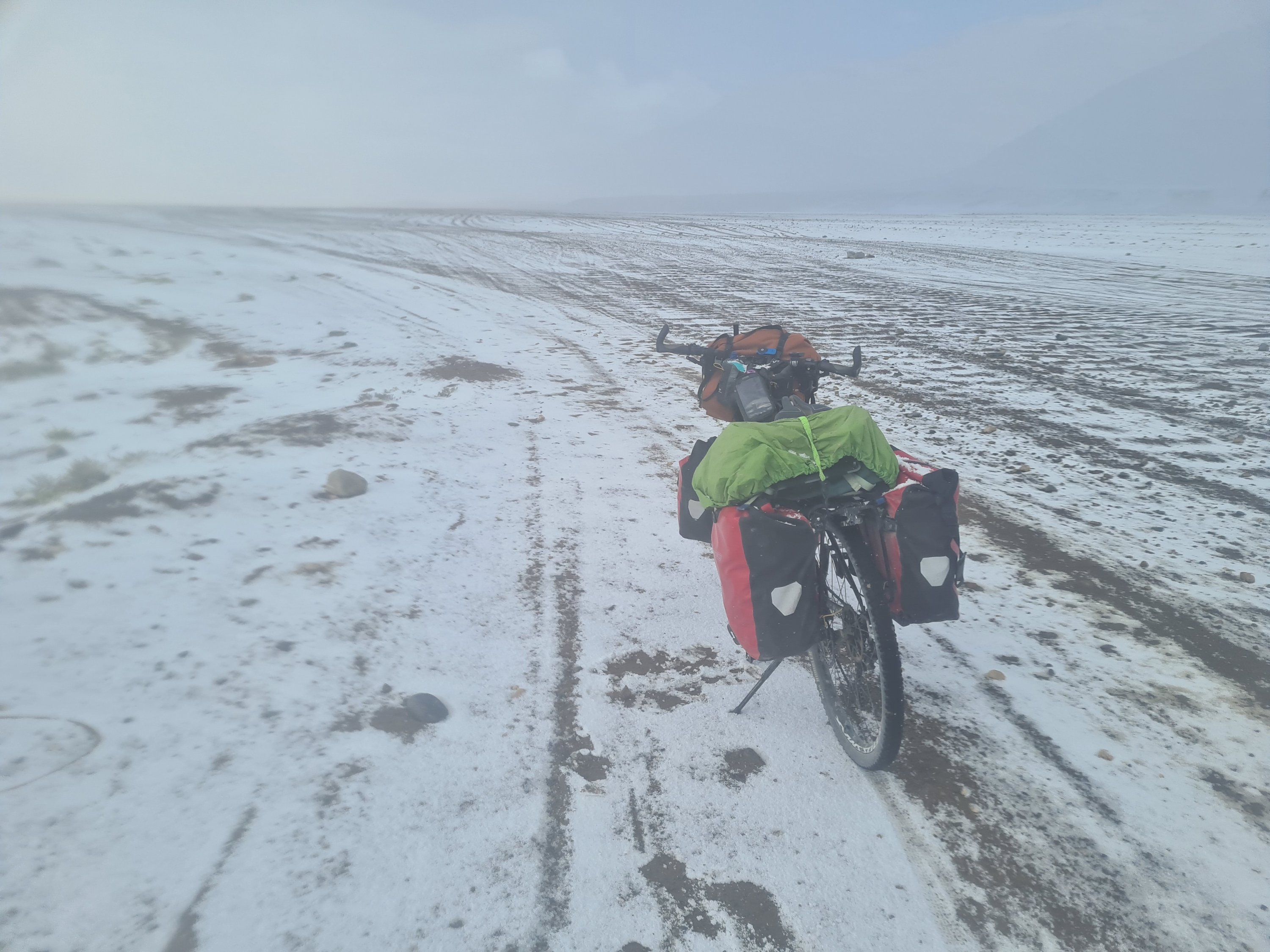
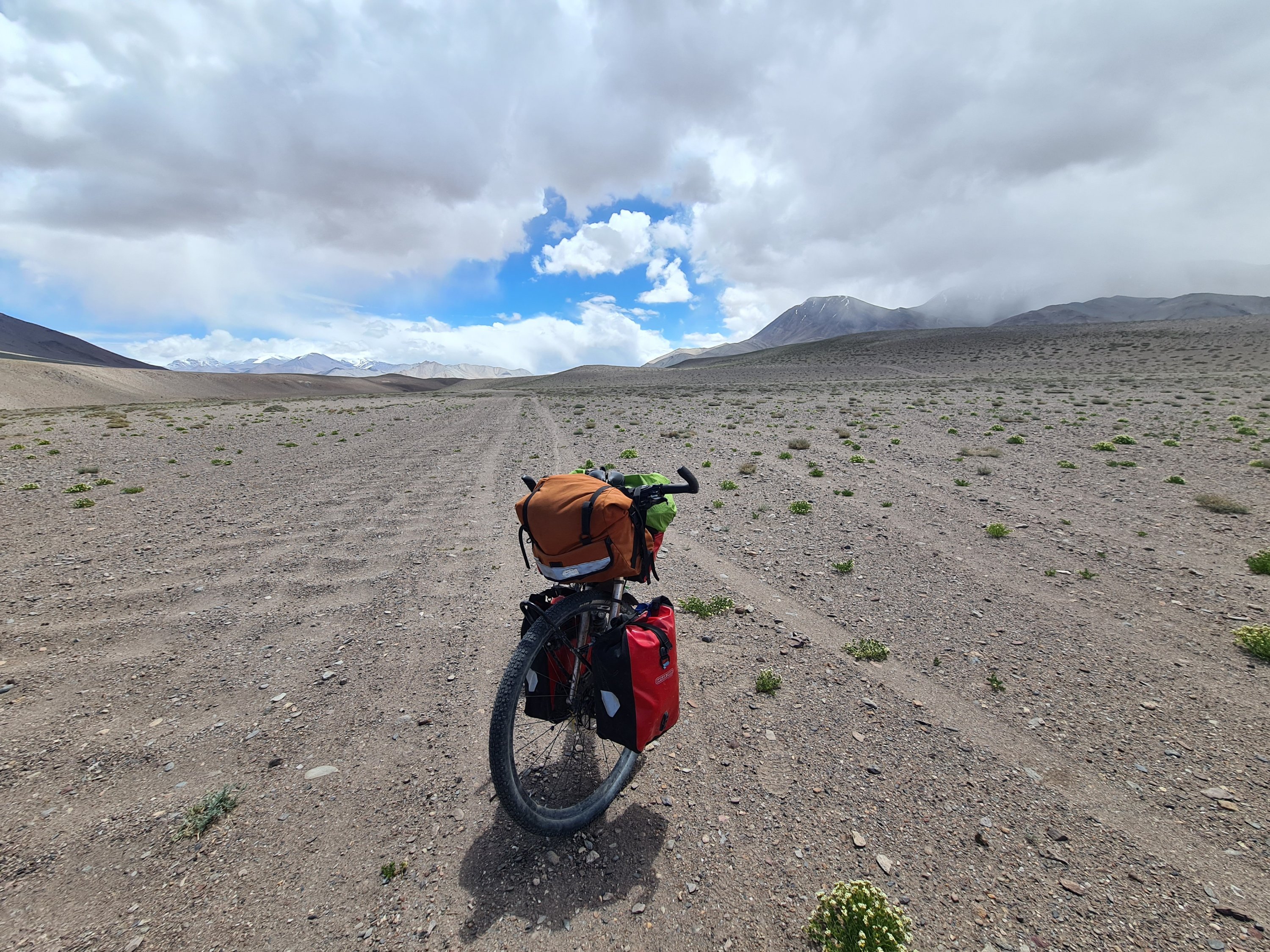
Once I got down to Bartang itself, well, the headwind started working against me, and I got some sand in my face, which was… not as fun. Me and the Belgian couple i've seen on and off during the first two days struggled quite a bit.
It takes about 150 km from Karakol until you reach the first village in Bartang, Guadara, and I reached it on the third day. being so far from the "main road" (which by itself was, as i described in the previous post, not a great highway), I expected to find a remote and desolate village, built totally of mud bricks, cut off from the rest of the world with no sign of "civilization". But then I crossed the small pass to it and saw… red roofs? Cell antenna? What ? I mean, yes, there were the mud houses, but also a nice straight row of houses that reminded me of old pictures of the village where i grew up, before the trees grew there.
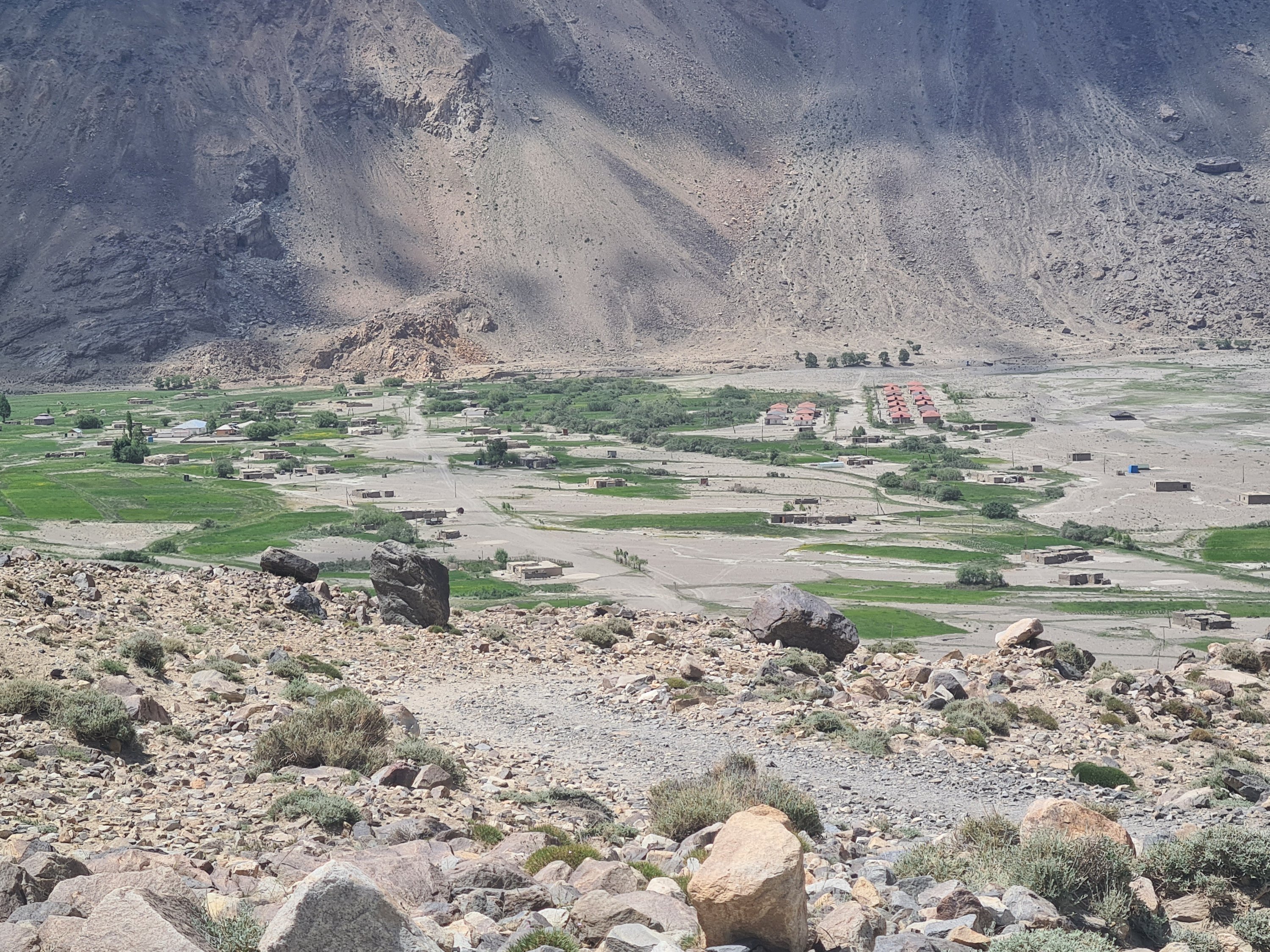
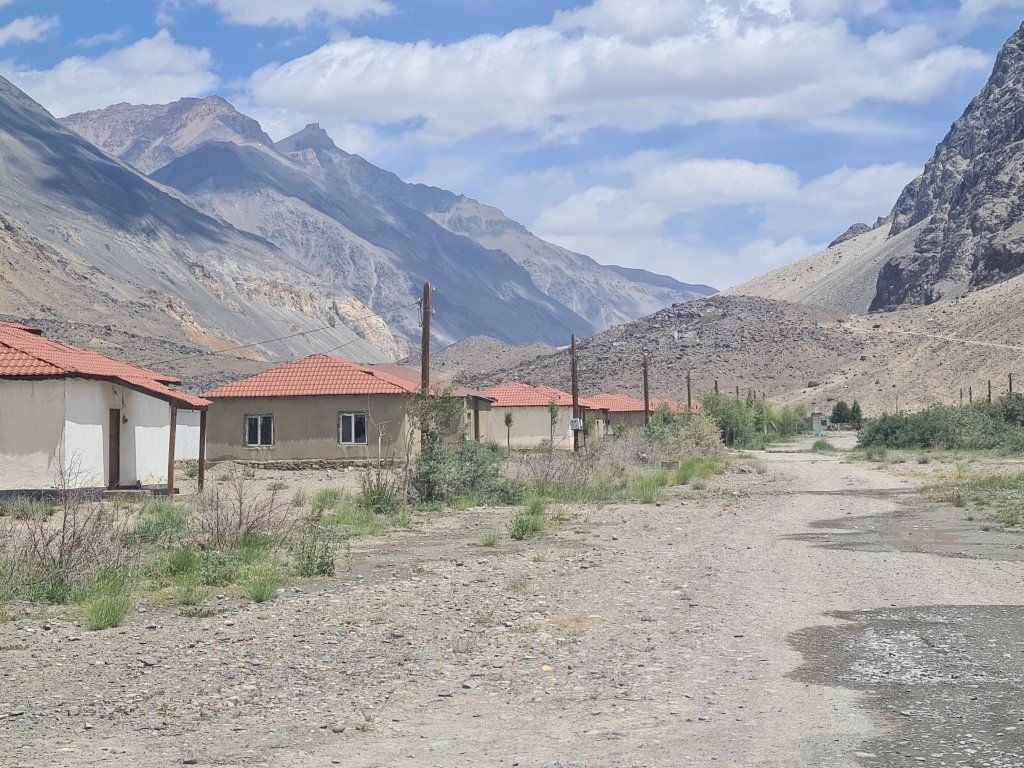
I stopped for tea (you are always always welcome for tea in Central Asia. So much tea) at some small guesthouse) and I talked to the owners about these new houses. It turns out that in 2016 there was an earthquake there that destroyed the village, so the government came in and built them new houses (and also installed a cellular antenna that receives electricity in a solar way). this is a surprising response from the Tajik government, who generally neglect the Pamir, but i guess they had their reasons (maybe score some PR points). However, at a quick glance, it seems that half of the houses are abandoned for some reason. When I tried to inquire with one of the locals in my very limited Russian, it sounded like, with all due respect to the new houses, people preferred to rebuild their old houses, which are closer to the fields and pastures (but take this explanation with a grain of salt, because as mentioned, I don't really speak Russian). I wonder if there is a lesson here about central planning, or if it was clear to the government in the first place, and it was simply a way for some contractor, who is someone,s cousin, to pad his pockets.
Another small note – while the owner of the guesthouse looks very Central Asian in appearance, when I saw his wife I thought at first that he went to Russia, married there and came back with his wife to live in the village. but no, she grew up in the neighboring village. And while this was a relatively extreme example, it wasn't really unusual – very interestingly, the deeper you go into the Pamir, the more facial features and hair colors look more… "European". Not Nordics or Germans, but definitely faces that would blend into the crowd in Italy or Eastern Europe. A friend who is interested in these things explained to me that as far as we know, these are Tuchars And other Indo-European tribes that came here from Eastern Europe (around the area of the northern Black Sea) in the first centuries AD, went deep into the mountains, and were never really assimilated by all the Iranian (i.e. tajik) or Turkish invasions that came later. And it should be noted that the Greeks also came here at the time, And they even established kingdoms here. In fact, when I asked a boy in the Wakan Valley about the fact that you occasionally see blond and red-haired children here, he said with a smile that they say those are descendants of Alexander the Great.
The fourth day was again with bad weather that obscured some of the more beautiful parts of Bartang, and was generally a bit of a bummer. I felt that at this point, i got the memo, and had my fill of rough dirt roads, and decided that even though I had planned for six days, I would leave the bartang tomorrow. so I got up at half past four in the morning for the sunrise, set off at six, and after eight hours of fairly determined riding I arrived at seven in the evening to Roshan, the terminus of the Bartang, having ridden 80km+ (almost twice of what i did the day before). i was quite exhausted, but happy. It's a pretty small town, and still, it was a little weird to be back in civilization, sort of. roads, cars, plenty of people. i didn't mind the hot shower, though.
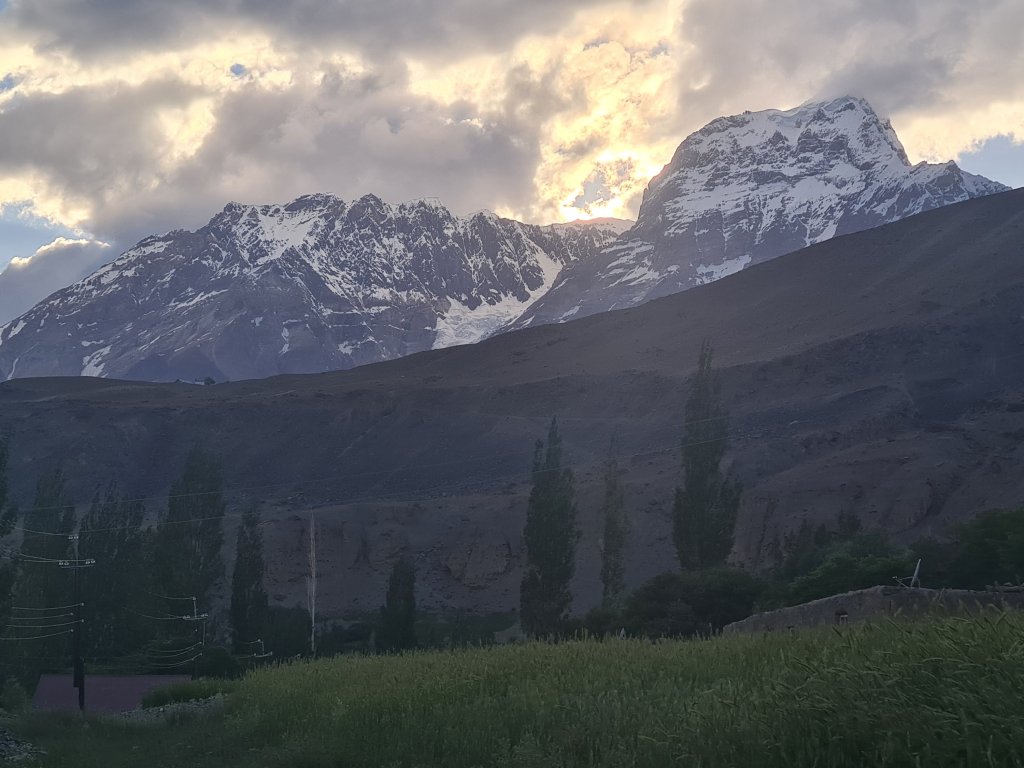
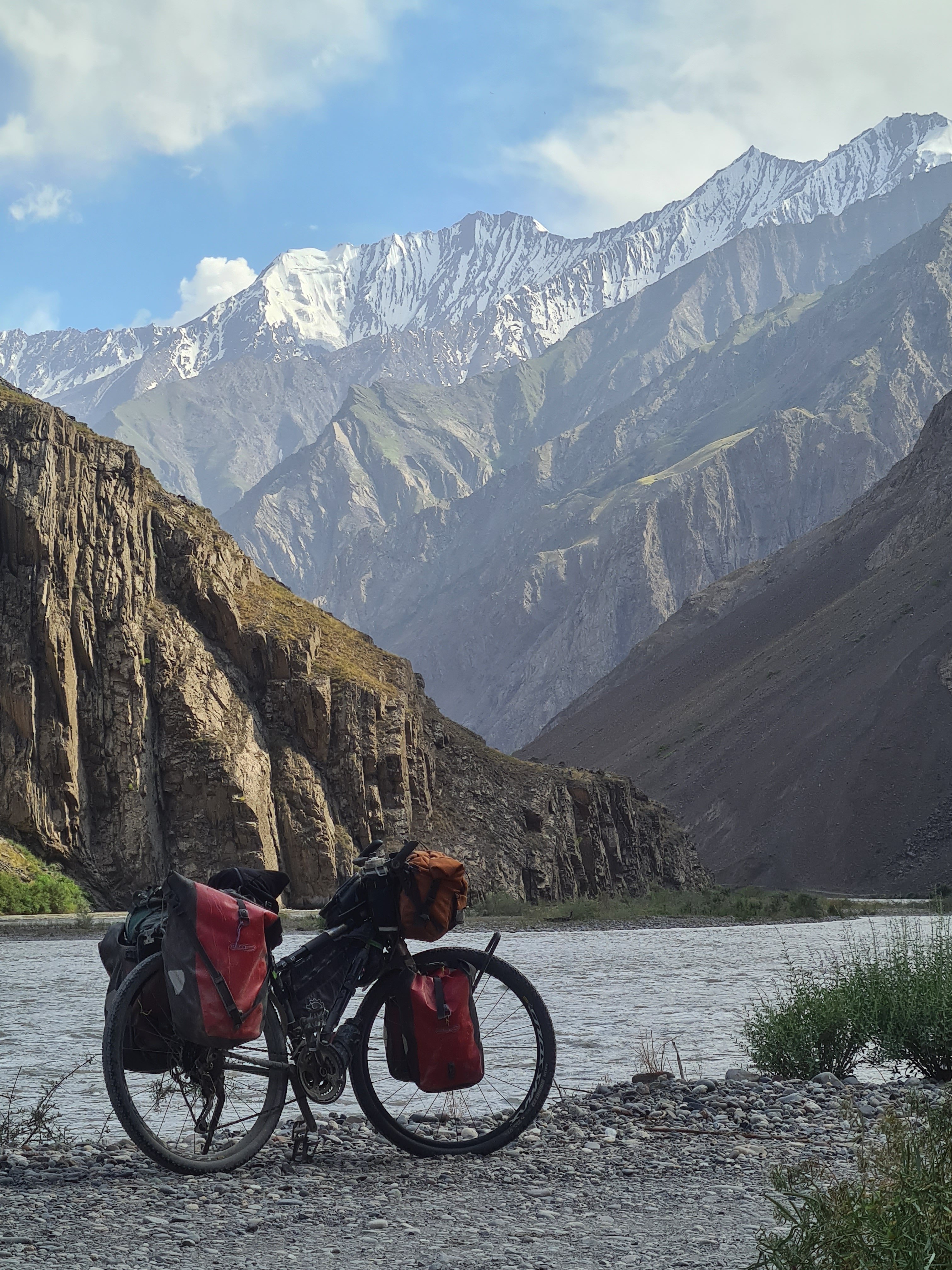
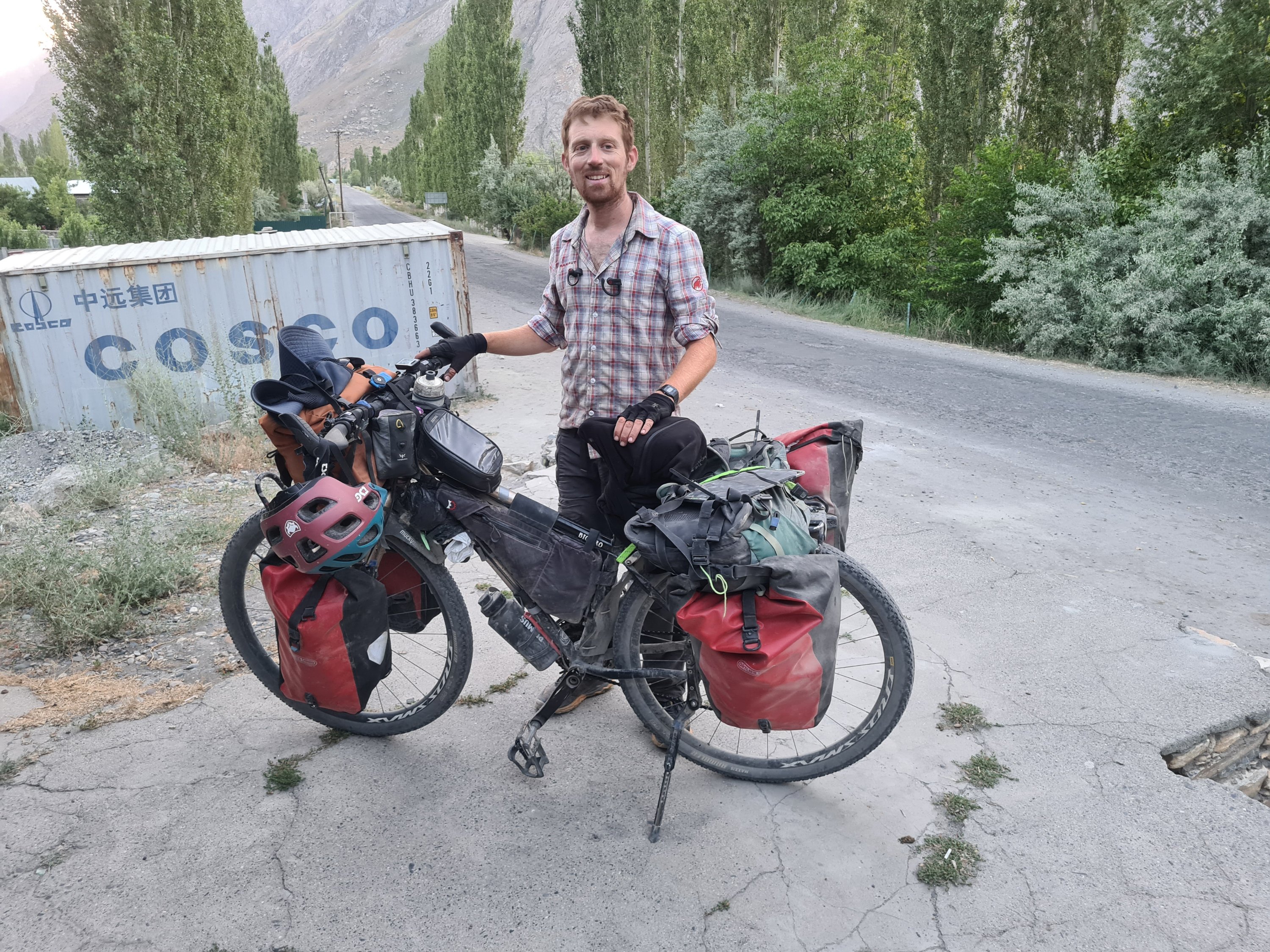
Roshan itself is a small, sleepy looking town. The first time I passed through it, on the way to Khoroug, Pia, Baldur and I raced through it without really stopping, and this time too I didn't see it as a particularly eventful and dramatic place (unlike the surrounding scenery, which was very much so).
Well, it's hard to explain how far from the truth that notion was, but I'll try.
the riots
On May 17, 2022, several dozen local residents set up an improvised barrier made of cars on the main road in the Roshan area. The goal was to block the military convoy that made its way to Khorug, where larger riots/demonstrations took place. The Tajik army decided to open the road no matter what, and at the end of that day, between the blockade in Roshan and the suppression of the demonstrations in Khorug, dozens of people were killed in clashes between the army and the locals , and hundreds of people were arrested. As often happens in those cases, the Tajik government claimed that these were criminal riots, and only 16 people were killed, and the Pamiris, on the other hand, claimed that these were peaceful demonstrations that were attacked by the army, and that about 50 people were killed. It was the first serious round in 2022 after several months of tension that erupted into violence between the Tajik government and the local population, but it was by no means the first round in the Pamir's contemporary history. But to explain where all this stems from, we'll have to go back 30 years.
When the Soviet Union disintegrated in the early 1990s, and all the Stans became independent states, each followed a different path. Uzbekistan, Kazakhstan and Turkmenistan have all become autocracies, though each with their own unique nuances and flavors (I'm sure some of you know the crazy stories about Turkmenistan). Kyrgyzstan did manage to become sort of a democracy, but in the 30 or so years since its independence, has gone through 3 revolutions (2005, 2010 and quite recently, in 2021).
Tajikistan has devolved into a civil war*. There is a tendency to describe it in terms of A. clan wars and B. Islamic insurgency, and there is some truth to that, but at the root of it, it was a power struggle between different power bases in Tajikistan, and They have parallels to different clans in the country, but it's more complex than that. As I wrote in the previous post, the people who held the reins of power when Tajikistan became independent, as in the other republics around, were the local Communist Party leader. Naturally, the communist apparatus did not have much sympathy for people who take religion too seriously, and the more pious Muslims (almost all Tajiks define themselves as Muslims, some are simply more pious than others) didn't really like the communists either. Beyond that, in Uzbekistan for example, the party did made sure that different regions in the country are represented within the ruling appartus, and the position of secretary rotated among them. In Tajikistan, by contrast, the power base of the communist leadership until the disintegration was almost exclusively concentrated in the region of Kujand (then Leninabad), in northern Tajikistan, and most of the important positions and resources flowed there. When Tajikistan gained independence, other areas of Tajikistan came to the conclusion that it was about time for a more fair distribution of power, but the Khojands didn't really want to let go. The Pamirs specifically never felt an integral part of Tajikistan, understandably (historically, ethnically, religiously, etc.) and there are claims that GBAO sought to achieve full independence under the auspices of the civil war (although this is a claim that is now denied by the Pamiris). At the same time, the more conservatives islamic parts in the population thought it was also time for a little more religious freedom than there was under communist rule, and since devout Muslims were *really* not the power base of the communist leadership, that didn't jive with the authorities either. Thus, a civil war broke out, that killed between 20,000 and 150,000 people , turned hundreds of thousands into refugees and pretty much destroyed Tajikistan, And especially the Pamir region, whose infrastructure has probably never fully recovered from the war. According to one source, only the AKF's humanitarian aid prevented mass death from starvation in GBAO.
During the civil war, the president of the Tajik government (the secretary of the communist party until a moment ago) was replaced by another man from the communist apparatus, Emomali Rahmon (then Rahmonov). Today Rahmon cultivates an image of someone who "brought peace to Tajikistan", but in practice he did not reconciled the differnet sides or anything, he was one of the sides, and agreed to the compromises that led to the end of the fighting.
Another claim is that another important factor in the achieving a cease fire was the Aga Khan himself, who made a decision whose consequences are difficult to assess to this day – he encouraged the Nizari ismaeli in the Pamirs to set aside their arms and sit down for negotiations with the government. the Pamiris trusted the Aga Khan (who for the first time since the arrival of the communists to the region could visit his followers in the Pamirs) far more than the Tajik government, did just that. I haven't found more than one source that claims this, so take it with a grain of salt, but what is clear is that, as of 2012, the Aga Khan and his foundations are definitely acting as a mediator in attempts to make peace in the Pamirs. This, as i'll soon describe, puts them in a very difficult position.
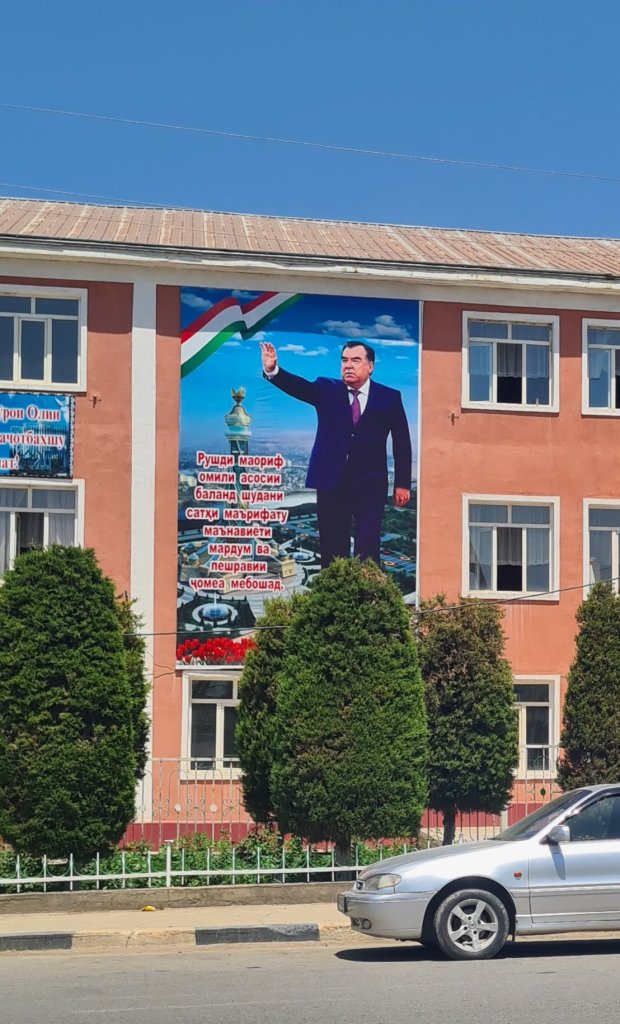
The compromises reached at the end of the civil war were supposed to give more freedom to the opposition movement, more freedom of religion and generally make Tajikistan a more democratic state. Among other things, they were also supposed to give more autonomy and self-government to the Pamirs. But in the years that followed, Rahmon, the president of Tajikistan managed to transfer to his side some powerful elements from the opposition and suppress/arrest/exile the rest, and thus fortify his rule more or less forever (Of course this comes with an inevitable cult of personality, and his chubby and very unimpressive figure waves you goodbye from every governmental and non-governmental building facade in Tajikistan. There is something about him that looks more like an amiable uncle than an uninhibited dictator, and in general he seems very uncharismatic, yet he and his family have ruled Tajikistan with an iron fist for thirty years). And it must be said – it seems that he does enjoy popularity among large sections of the population, among other things because he certainly succeeded in creating the narrative of "I am a strong leader who prevents the return of the civil war and stirfe", and people *really* do not want to return to those days.
And as the goverment in Dushanbe became more and more entrenched, it seems that they decided it was time to strengthen their hold in the Pamirs as well, at the expense of the local Pamir society. They claim that the Pamirs is/was controlled by a bunch of criminal elements/mafiosi, former leaders in the civil war, called "the commanders", and they are just trying to establish some law and order. The Pamirs see the commanders as local leaders and heroes who lead civil society in the Pamirs, and the government is simply trying to crush that society. Either way, since 2012 there seem to be repeated rounds of violence every few years, with the Tajik military eliminating local leaders, which leads to riots, which leads to more violence, when the last round was literally last year. As a traveler, oddly enough, you experience very little of this – you do see a serious military presence throughout the Pamirs, and of course you have to show your GBAO permit everywhere, but I talked to people who were in the Pamirs in the summer of 2022, and even they didn't know about the riots. Apparently, by the way, the official reason for the GBAO permit is that it is a sensitive border area with Afghanistan, so you need permission to enter there, but it seems quite clear that this is simply another way to control the local population (the border with Afghanistan also extends far beyond the area where you need the GBAO permit)
As mentioned, the Aga Khan is in a problematic position throughout the story. On the one hand, the chronically impoverished Tajik government is always happy to have someone else foot the bill for all the infrastructure projects in the Pamirs (like say the Chinese government and their road, or the AKDN electric grid). On the other hand, they have no interest in having the AKF strengthening the local civil society in the pamirs, and regards the Agha Khan with heavy suspicion. The AKF, for its part, obviously needs the premission of the Tajik government to operate in the Pamirs at all, and does not want to be thrown out. but on the other hand, no, they do not want to lose the trust of the local community in the leadership of the Aga Khan by taking too much of a conciliatory position towards the Tajik government. and the problem is that as an intermediary, the Aga khan don't have any international authority like, say, the UN or a third party country, and there is nothing they can do to prevent the Tajik government from renagging on its promises and compromises, which it has done in the past.
The future of the Pamir looks pretty bleak in that sense, at least according to the articles I've read. While the 2012 round probably actually strengthened autonomy in the Pamirs, and led to an agreement to withdraw Tajik army forces from the Pamirs, in recent years the Tajik government seems to be winning, and the Pamirs are slowly being pushed out of positions of power, and officials from Dushanbe are appointed as governors and mayors. Together with the new and fast road that the Chinese are building to Khorug and beyond, and the fact that Rahmon is not going anywhere (he entered the position relatively young) it seems that the process of political integration of the pamirs into Tajikistan's political system (i.e. the the dictatorship) is inevitable, and that's… sucks. As I said in a previous post, the Pamirs are probably going to be a very different place in the near future, and I'm not sure in a positive way, at least for the local residents.
But for my part, I ended my journey in the Pamirs. After another short trek in the area, I took a long long taxi from Roshan back to Dushanbe (and when I say long, I mean we left at 11 am and arrived at 7 am the next day). On the way I was amazed to find out how long it took the car to cover the distance I did by bike. I usually expect an one to two hours drive for a day of riding, but since this road is so crappy, it turns out that bicycles have a significant advantage… On the way back we got stuck in the Chinese works, of course, and after we were able to continue, we stopped again, in the dark, when we had to clear stones that had fallen onto the road (and then quickly escape when they seem to start falling again). It turned out that the Pamir is an adventure on the way out as well.
and onward
And that's it, I end this post in Almaty, the Tel Aviv of Kazakhstan. It's hard for me to summarize my journey in Central Asia, there is so much to say. I will say that in addition to being the country where I spent the most time in the region (two months on the hour), Tajikistan is also my favorite country in Central Asia. The Uzbeks probably win the niceness contest (although it's a tough competition), and Samarkand, Bukhara and especially Khiva are beautiful, but for me, the ride between them was hot, flat and not the most interesting, minus the stolen bag and the Houbaras. What's more, they are undoubtedly in tourist-overload mode. I wrote my opinion about Kyrgyzstan in the previous post- It is incredibly beautiful like Tajikistan, but the feeling of "people don't come here for a long weekend" is much weaker. And the Kyrgyz, god bless, are pretty lousy drivers (it's not like the Tajiks and Uzbeks are Swiss, but the kyrgys- jesus). It was nice to return to paved roads in Kazakhstan (it's funny that Sasha Baron Cohen chose Kazakhstan as the country of origin of Borat, when it is by far the most developed country in the region), And Shirin Canyon was quite beautiful, but I'm here for a week, and the rest of my time here will probably be spent on logistics, so I don't expect to get too attached to the place. Tajikistan was, and I know I use this word too much, a real adventure, in the simple sense that I'm going to remember what I experienced there for long time to come. With all its problems, and it has quite a few, it is a wonderful country with wonderful people (only the government leaves something to aspire…).
And that's it, the Caucasian part of the journey will soon begin. Due to a lack of thorough planning in advance, and geopolitical bad luck, it turned out that my route is a bit… fragmented. I admit that when I meet riders who can now say "yes, I rode here from Switzerland/Holland/Germany" I feel a pinch of envy (even if most of them had to fly over Azerbaijan). There is some value in a continuous journey, in which you can say to yourself – I started riding on one side of the continent and ended on the other side. At least for me. Also the fact that now, after so much time riding east, I'm actually taking a long flight west, skipping over my starting point (Khiva) and continuing far beyond, to Tbilisi, is strange to me, and somewhat disconnects this part of the journey from the next part of it. And yet, in this specific case, I do think that the decision to ride Central Asia from west to east was nevertheless a good decision in retrospect. In terms of the seasons, in terms of the direction of the winds and in terms of company – I got to ride with a lot of nice people on the way, and I was happy to meet them.
I'm also a little worried about the next part, because i'm afraid that riding the Caucasus, and especially Turkey, after Central Asia, will feel much less like an adventure – everything will be much less remote and different, more people will speak English, and the landscapes are less dramatic. But I hope I will know how to find the adventure in this part of the trip as well (and if not, I will know how to find the closest train). I will probably take a break from the blog for the time being, but I believe that until Istanbul there will be another post here. See you on the Bosphorus.
 יצאתי לשאוף קצת רוח