[So this post was originally a thread I wrote for Twitter, but since it's something exciting that happened to me on the trip, I'll share it on the blog as well. For those who have Twitter, I think it's worth seeing it there , because it's adapted to the format, and also because there the videos are embedded and not external links, but for the benefit of those who don't have, well, i hope you like geeking out on bicycle infrastructure, because there's 3000 words of that here]
1. Last week I got an amazing opportunity, thanks to Eyal Santo and his vast connections, to hang out for half a day with Bern's chief bicycle infrastructure planner, Michael Liebi, and with the director of the walking and cycling unit, Stephanie Stutz. and what can i say, it was without a doubt one of the coolest days I've had on this journey. monstrous post ahead!
Before I start, I'll just say that they are both incredibly nice people. Moreover, they came to meet and hang out with me on Saturday (Michael was with me for six hours!), which is amazing to me, and just shows how much this issue for them is not just "work", but something they truly believe. Stephanie also offered to host me at her house halfway from Bern to Basel, simply because she is a good person.
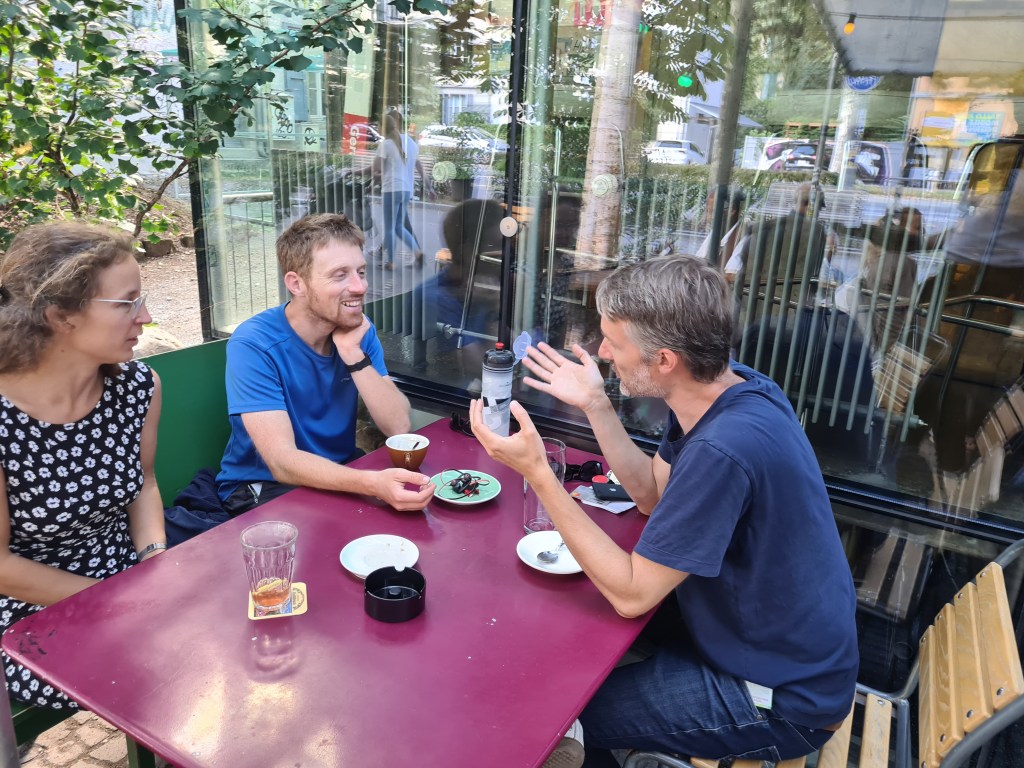
On a side note, although Stephanie lives about 40 km from Bern in the most rural and pastoral area imaginable, her dilemma in the morning is not which car to take but whether to cycle to the nearest train station or take the bus that stops right below her house, while her spouse brings their son to the kindergarten in the nearby town with cargo bikes (the older ones take the bus). Welcome to Switzerland!
2. anyway, we started the tour at the train station, which is packed to the brim with bicycles parking at street level. Michael explained that they would have been happy to add more parking facilities, but there is a conflict with city planning, which wants to keep as much of the space open as possible. City planning also do not allow two-story facilities, because it doesn't look good, in their opinion.
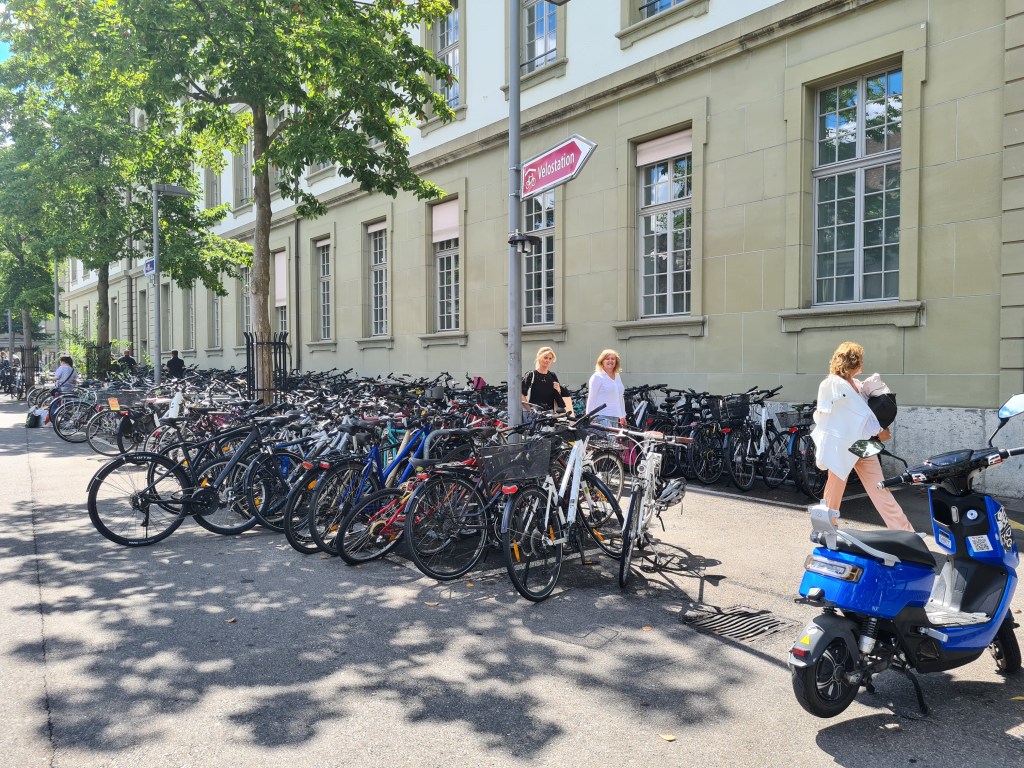
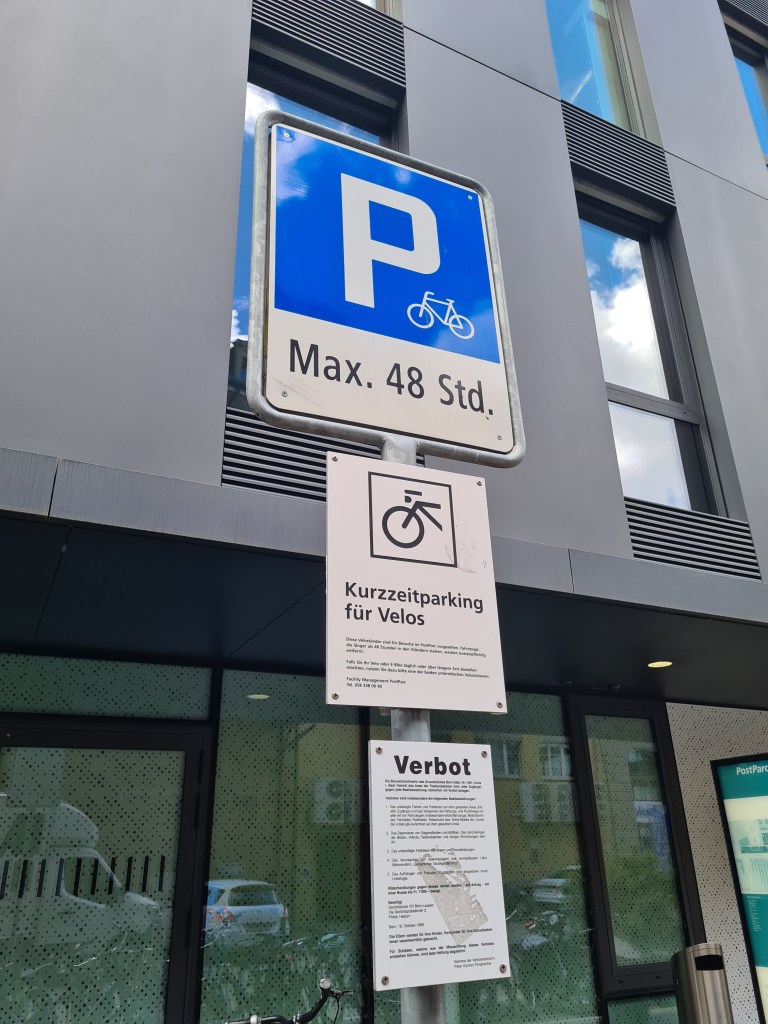
3. Parking on the street level is limited to 48 hours, but in practice there is no enforcement, because the municipal inspectors do not have the authority to throw away old bicycles, only the canton police. But from a quick check, there doesn't seem to be any abandoned bikes there. The parking lots are literally full of bicycles in use.
4. Michael said that they have about 4,000 parking spaces in the area, but they think they need 5,000, and by 2030 they will need 10,000, and they are working hard on it. Since it is not possible to add more above ground, they are working on adding more parking *under* the ground, and there, they have already done a very impressive job.
5. Indeed, from there we moved to the underground bicycle station. You can put a bicycle on the train with an additional ticket, but it seems that when you provide a good parking solution, people use it, because this station was almost completely full. Basically, you pay either a daily ticket (1 franc), or you buy an annual subscription (150 francs).
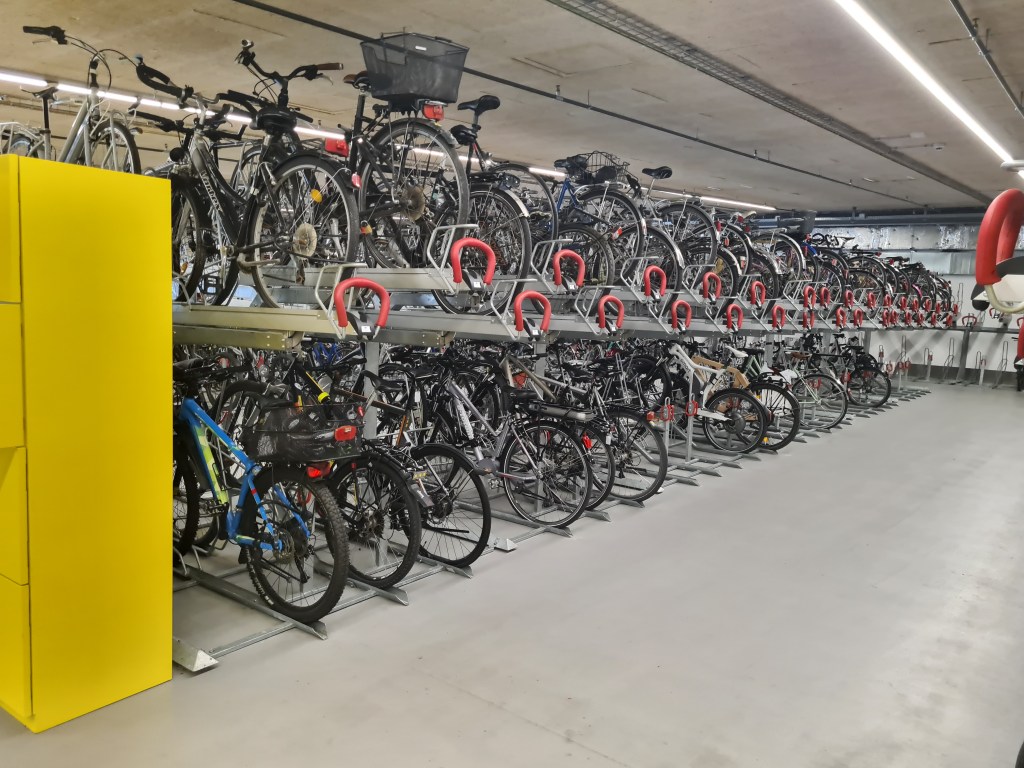
6. For occasional use, the station is open from seven in the morning to eight in the evening, but subscribers have a key/code.
There was an interesting overhead hanging facility on the third level, which should be more accessible than the facility in the middle (I'm not a big fan of the two-story facilities), but it wasn't active at the time for some reason.
7. The coolest part was how accessible it was – the entrance to this facility was right next to the station, and it had an exit right to the platform corridor. Since this was the first facility they built, the entry of the bikes was by walking on the ramp, not riding, like it's done in the next facility, but the ramp was well built and easy to use.
8. From there we moved to the next facility, which was accessible by bike , but less used (about 50%), because the entrance to it was through a much more hidden and much less friendly street. The entrance from it to the platforms was still quite close (one elevator), and there was of course a repair station and a place to buy basic equipment (tubes, lights, etc.).
9. But the thing I liked the most at the station was the bicycle cleaning station. The cleaning station is intended for people who, let's say, have just returned from a offroad ride with a dirty bike, or their bike just got dirty from use and they live in a small apartment without a yard or a decent place to clean it, and here they can do it. And that's wonderful to me.
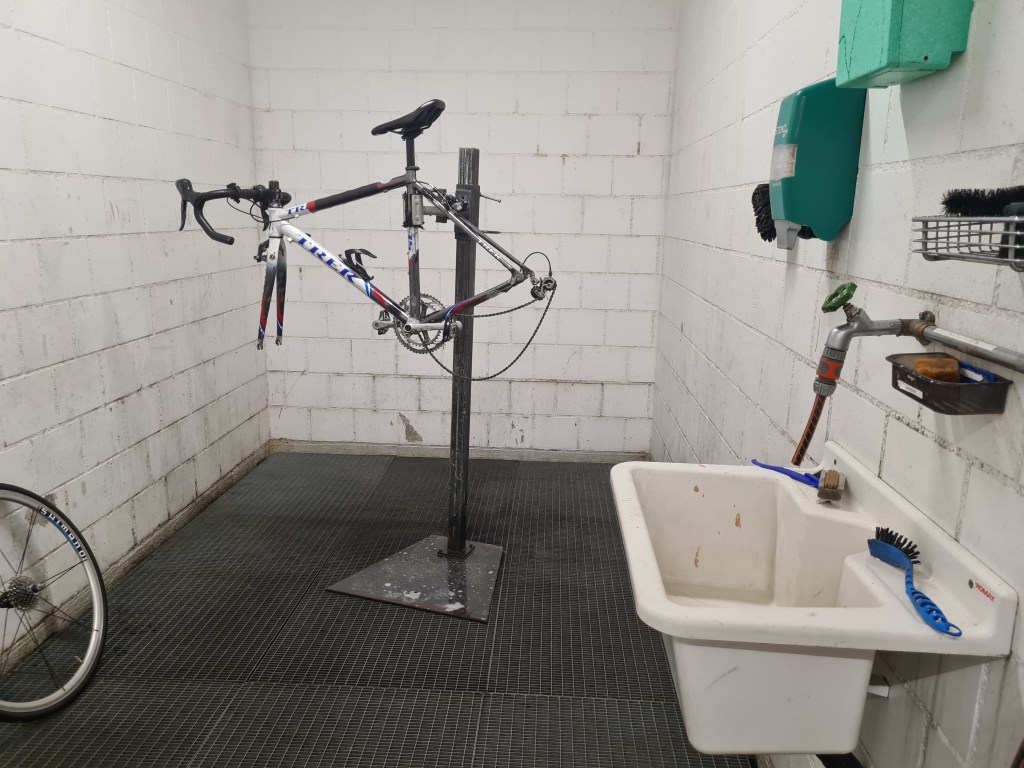
10. Because a dirty bicycle is not some obstacle that needs to be solved in order for people to start riding, like, let's say, paths or parking. No, it is simply to look at the cyclists as citizens for whom the experience of using a bicycle can be improved, and then go and improve it. Not because otherwise they will switch to using a car, but because we want to give them a good user experience.
11. The station area is still not the most friendly for bicycles and pedestrians, but they are working on it. "Not Just bikes" recently released a video about Switzerland, in which he said that Bern is more friendly to private vehicles than Basel. Michael commented that the guy arrived by train to the center of Basel and the center Bren, looked around and drew conclusions based on first impressions.
12. And it is true that outside the train station in Basel there is a very nice square for cyclists and pedestrians and in Bern it is still being planned. But when you look at the distribution of travel, well, the distribution of travel by car is quite the same, and in fact my host in Basel said that in her experience it's the other way around – Bern is much less car-friendly than Basel.
13. In my experience, the bike infrastructure in Basel felt no better than Bern, sometimes worse. The only thing that was better was their bicycle parking lot , which was *crazy*, but I think it's more due to the fact that Basel has more money than Bern, and more importantly, has more independence to use it, because they are not part of a canton but a canton in themselves.
14. By the way, in terms of data, according to the 2015 census, Bern stood for a distribution of 15% of trips by bicycle, which is very, very nice. He says that at the same time they are doing counts, and that the numbers have increased since 2015 by 60%, but this is not necessarily correlative to the distribution of travel, and next year there should finally be another census and we will find out what the situation really is.
15. In Basel, if we go back there for a moment, the distribution of trips by bicycle was 17% I think. I definitely felt that there were more cyclists there, and maybe they did progress faster in the last 8 years, but on the other hand, Basel has almost twice as many people as Bern, and it is the most crowded city in Switzerland. In any case, one should be careful with the first impression of cities.
16. From there we moved on to ride through the city. It should be said that the reason I became interested in Bern in the first place is that I realized that it is a mountainous city, but with bicycle infrastructure and especially with high percentages of use. So, the second part is true, but it turns out that Bern isn't as mountainous as I thought it would be. There are serious height differences there, but much of it is the river, and quite a few bridges pass over it. It's definitely not a flat city, it's relatively mountainous, and there's something to learn from how they deal with topography (more on that later), but it's not as mountainous as Jerusalem.
17. And yet, even if it was mountainous like Jerusalem, I don't think that at this point it would have mattered. The amount of standard electric bikes you see on the streets is simply impressive. In Switzerland they also have a standard for bicycles that reach 45 km/h that require a helmet and a license plate. But all electric bicycles require pedals and do not have a throttle.
18. When we talked about planning routes, Michel said it was quite simple, because the bridges pretty much mark the routes. There is sometimes a debate about whether to move the bikes on winding routes through the neighborhoods to the bridges, or on the more main roads and take space from the highway, and sometimes they win this debate and sometimes they lose.
19. One of the things he showed me when we were riding was the old markings of the bike lanes . They recently started working on a significant expansion of the bike lanes in the city. Every centimeter that can be expanded, they expand. The ideal they set is one-way bike lanes of 2.5 meters *in one direction*.
20. And when I say they set an ideal for themselves, I mean they wrote it explicitly in their master plan. He said that their master plan was less concerned with how exactly the network would look, because these things always change, but more on a declarative level, how the infrastructure should look and who it should serve.
21. As part of this, they specifically wrote that they wanted their paths to be 2.5 meters in one direction, which kind of bound the municipality to do it, because when the cyclists see a plan of a path that is narrower than that, they now stand up and say to the municipality "wait, but you yourself said it should be 2.5 ".
22. By the way, when I told them that there are streets in Jerusalem where they plan to make 2-meter *two-way* paths, they were very alarmed, and even more so when I told them that these were streets with significant elevation. When the space is tight, they solve it in a very different way, and more on that later.
23. We had an interesting discussion about what a 2.5 meter one-way path is for. Is it designed to allow fast riders to overtake, or is it designed to allow riders to ride next to each other and talk, for the benefit of a more social riding experience? He said that this is something they do not intend to "plan", but to let the norm establish itself, because not everything can or should be planned. I liked that.
24. In general, there was a lot of discussion about who are we planning the infrastructure for, and about working with riders' organizations. It sounds like they're on pretty good terms with them, meet with them once every two months, and even went out with them for a beer. Michel also said that although it's not an official rule, he usually doesn't move forward with infrastructure if it doesn't have the support of the riders.
25. Because simply, he knows that any change he makes will be opposed by the car owners, so he wants at least the riders' organizations to be on his side. And beyond that, many of the planners in the municipality are riders themselves, and even skilled riders.
26. One of the things I was most excited about was the double turn . At one of the intersections, they officially implemented *two* types of left turns – one method through a bike box, for riders who feel comfortable merging into the center of the road, and one with a method I'll call the "European" method, of continuing straight and then merging in front of the cars that continue onto this street.
27. The first method is suitable for riders who prefer a faster crossing, and the second method is suitable for riders who prefer a slower crossing, but with fewer conflicts. And that is one of the things I strongly believe in. When planning infrastructure, one must think about *two* types of riders, the commuter cyclists who have already gained skill and the beginner cyclists.
28. And yes, sometimes it also means two types of *infrastructure*. It's not like planning for a private car, where, for justified reasons, one size fits all. The behavior and needs of a cyclist who has been riding for fifteen years are different from the behavior and needs of a cyclist who just started riding, or the one we want to encourage to do that.
29. For example, I absolutely believe that the regulation that says that if there is a bicycle path, then the cyclists must use it, should be abolished. all the on-sidewalk paths that have been implemented in Israel in the last 20 years might somehow work for new cyclists, but we really don't want some FYM (Fearless Young Man) on a single speed bike racing through it, and he doesn't want to either.
30. There was another place that demonstrated this, in an even cooler way. After one the bridge (which they repaired and widened the lane). They installed a waiting bay designed for turning left , and includes a traffic light and a bicycle sensor that stops the traffic and allows you to cross some 2-3 lanes at once to turn left without getting involved with the traffic.
31. And here is a real demonstration . You see a rider who prefers to simply cross the lanes and reaches the left turn directly, followed by another rider who uses the bay. In general, the division into beginners and skilled is also non-binary and can represent the same rider in different situations (fast vs. calm).
32. One of the things that was really interesting to me was how they dealt with a particularly narrow street . They gave the cars the minimum possible, deleted the separation line in the middle, and simply accept that when cars come in front of each other, they slightly cross into the path. I think this is an excellent solution, and for example it would be possible to implement it on Osishkin Street in the JLM.
33. And now we come to the thing that interested me the most – dealing with topography. Because as you can see in this video , the first thing they take care of on a sloping street is to create a *wide* path on the way up, even if that means there is no room left for the path on the way down. And that, friends, is exactly what we demand on Eleazar Modai Street.
34. I really don't understand how the planners there think that a 2-meter one-way path on a sloping street, which goes up on the sidewalk, is a reasonable path in anyway. I really hope that the municipality get a hold of itself as soon as possible (for those who are not familiar with the discussion, just look for "Elazar haModai" on Twitter, I'm basically the only one who writes about it).
35. From there we moved on to look at a solution for bus stops and meeting pedestrians. I personally support a flat level for crosswalk users, one that takes cyclists up a short ramp to a sort of an elevated crossing. But Michael said the regulations regarding accessibility for the blind say that there should be explicit markings that separate the trail from the sidewalk everywhere.
36. So in this place they have a sloped stone, 4 cm high and 15 cm wide, which separates the sidewalk from the bike path ,and it seems that at least for them it works well, and is supported by all the parties involved- cyclists, accessibility organizations, etc. The other advantage of the sloped stone is that if you accidentally hit it with the wheel, you don't fly off the bike.
37. For a long time, I was quite opposed to any level separation that is less than 10 centimeters, since i suspect than any less than that will mean people walking on the bike paths. But these days I'm not so sure about that, it seems that it works for them. On the other hand, yes, cultural considerations should be taken into account. The Swiss are not some miraculous creatures, and I have seen vehicles driving wildly, but on average, yes, people follow the rules more.
38. Another example related to this in public transportation is how they resolved a local conflict between bicycles and buses – they put a traffic light for bicycles that let the bus pass first (watch the video). This seems like a great solution, if you assume people will obey the traffic lights. dilemma.
39. In general, a significant part of the bicycle infrastructure is shared lanes with public transport. It felt good, and it is probably related to the fact that all the bus drivers in Bern undergo a dedicated training on the subject, where they are simply being put on a bicycle and experience the city by riding. Amazing. This program, btw, is called "David and Goliath", which by itself is wonderful.
40. Michael let me take a ride on their surprisingly successful public bikes. The crazy thing is that the municipality of Bern did not pay a single franc for this setup. When they announced a tender in 2017, it was the peak of hype around bike sharing systems, and one of the companies that approached, Publibike, said it would provide the system *for free*.
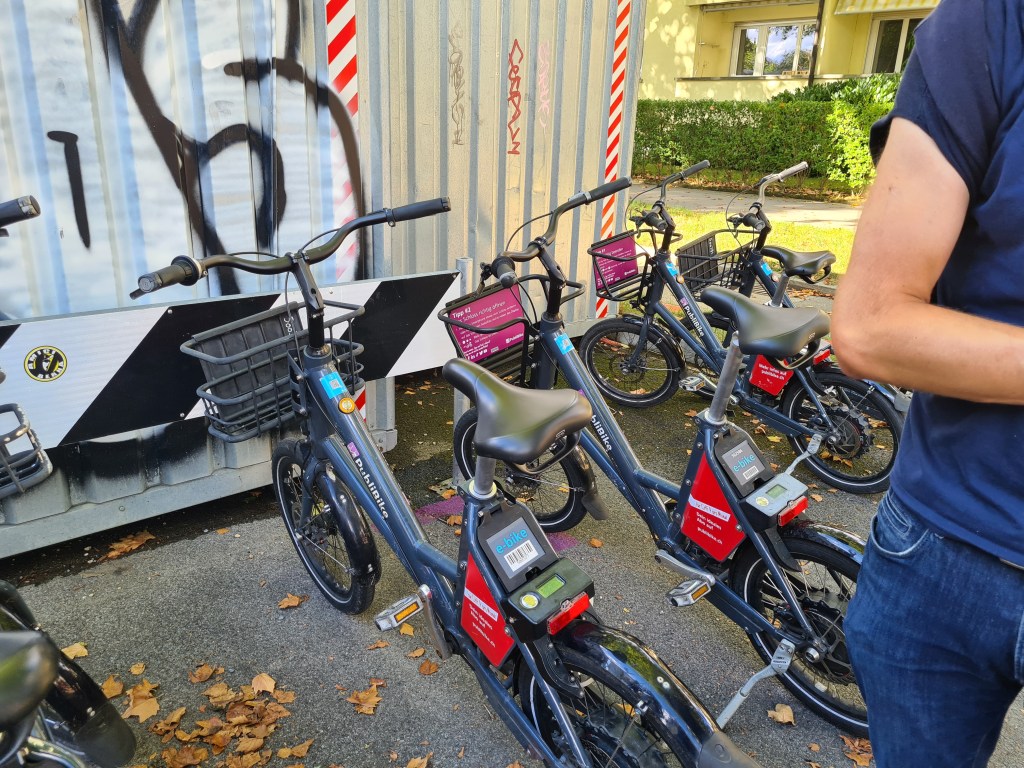
41. When they asked where they would make money, Publibike's answer was something like "advertising-data-something", when in practice it seems to me that, like many companies of these kind, the actual answer was "investors' money". After Publibike started operating, they realized they had stuck themselves in a serious financial hole, but a contract is a contract.
42. This contract ends next year, but if the conditions are reasonable, the municipality of Bern has no hesitation about renewing this contract – these bikes are very popular in the city, and they register about a million trips a year in a city of about 150,000 people, which are quite impressive numbers.
43. One of the accidental success factors was that due to a malfunction in the lock, some teenagers discovered that if they hit it lightly in the right place, it would open. For one weekend all the youth of Bern took these bikes out on a funride. The fault was fixed, but the bike continued to be very popular among teenagers. Very organic viral advertising, one might say.
44. And finally, one of the ways that Publibike does make money is contracts with large entities, such as the municipality, hospitals, etc., that give their employees the use of Publibike as a benefit. @Yerusalem Municipality, if you feel like helping Yerufan, who we all know is not doing great, and along the way encourage your employees to use bicycles, well, go for it.
45. One theme that came up again and again was the relationship with the canton. Bern is a very liberal and pro-environmental city, but the cantonal government it is in is very conservative. So pretty regularly, on streets where the city has full control, pedestrians and bicycles get priority, and streets that are under the canton, well, less so.
46. The paths really become narrower when you leave the municipal limits of Bern, and every struggle becomes much more difficult. This is kind of the opposite of what is happening in Israel, where the Ministry of Transport is the main pusher of bicycle infrastructure and public transportation at the expense of the private cars, and it is the municipalities (hey there Ramat Gan!) who put obstacles in the way.
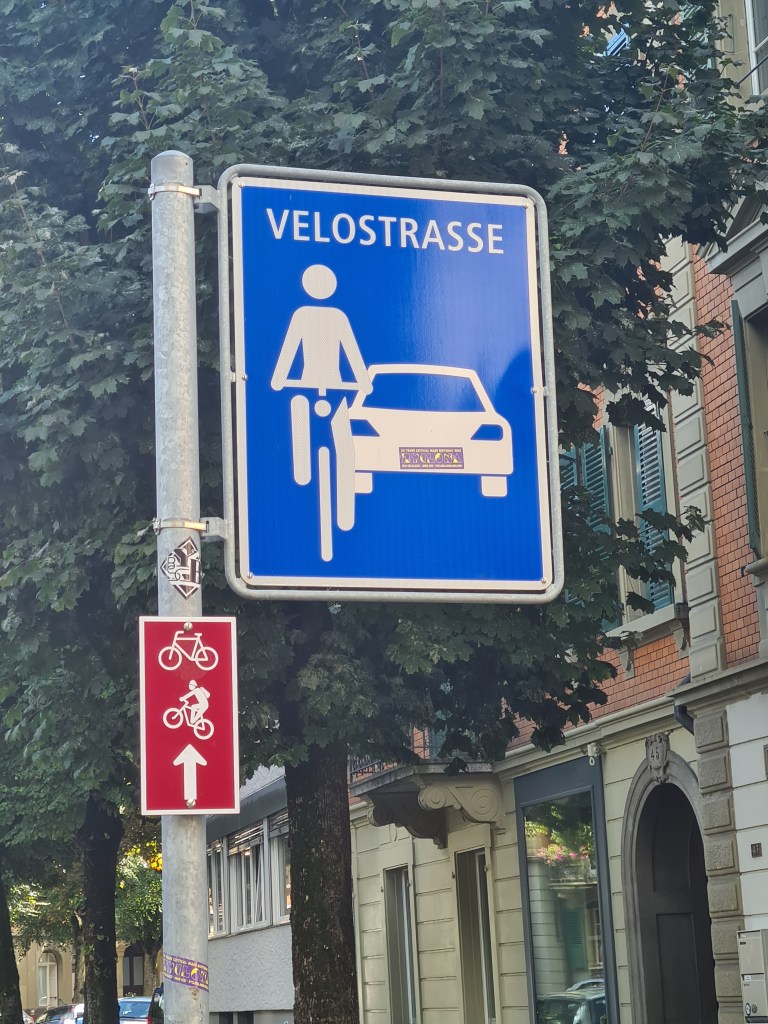
47. Another amusing example is a sign they used in the pilot for a bicycle street, and the canton did not approve it. Michael said that the stereotype about the people of Bern is that they are a little slow, so in this case they decided to stick to the stereotype and be slow in taking the sign down, so it is still there.
48. Another interesting topic that came up is the weather. Naturally, the challenges they experience are mainly in the winter, when cycling drops by about 50%. They are trying to deal with this by prioritizing snow removal from the paths and sidewalks, but this is a pilot that has only been partially successful.
But as you have noticed, the climate changes.
49. Last winter in Bern there was almost no snow at all, but the heat wave that was in Europe two weeks ago for example was quite unprecedented. The point is that they realize that they need to start addressing different climate problems than they have faced in the past, problems more similar to ours, with similar solutions – shade, showers, etc. this is going to be interesting to follow.
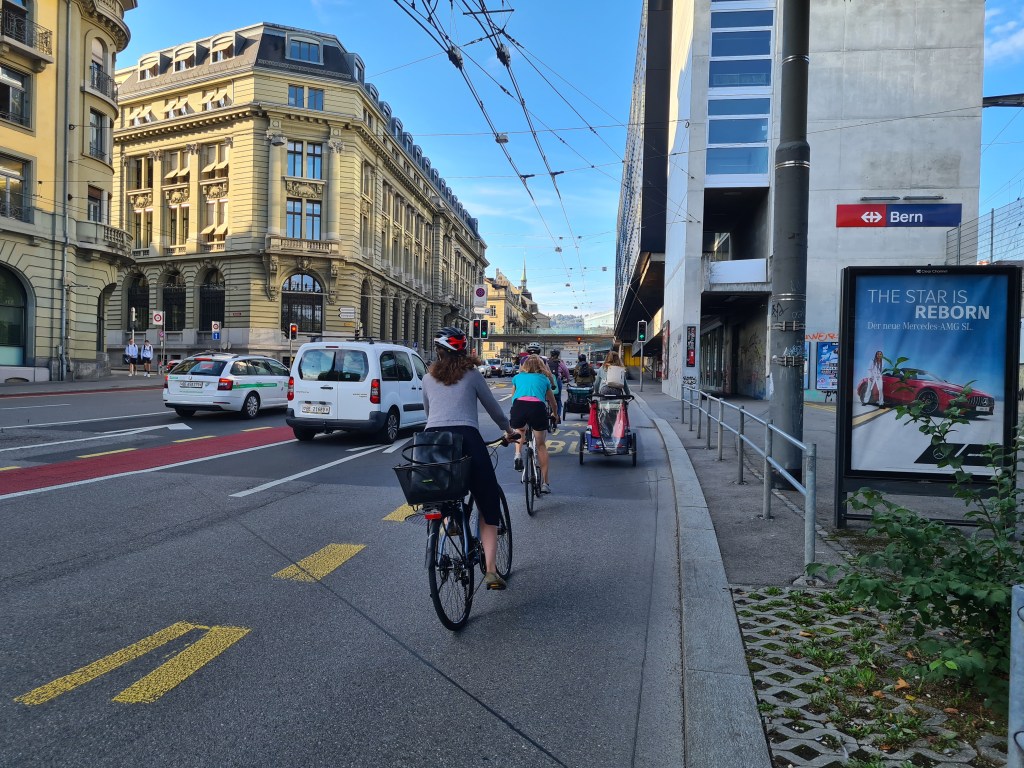
50. So, to sum things up – Look, Bern is really not a perfect bicycle city, and Michel and Stefanie will be the first to say it. There are still many very bad streets throughout the city that can be much better . They themselves do training in the Netherlands, to learn what other things can be applied, and in general, they sometimes win their battles, and sometimes they lose. This is work in progress.
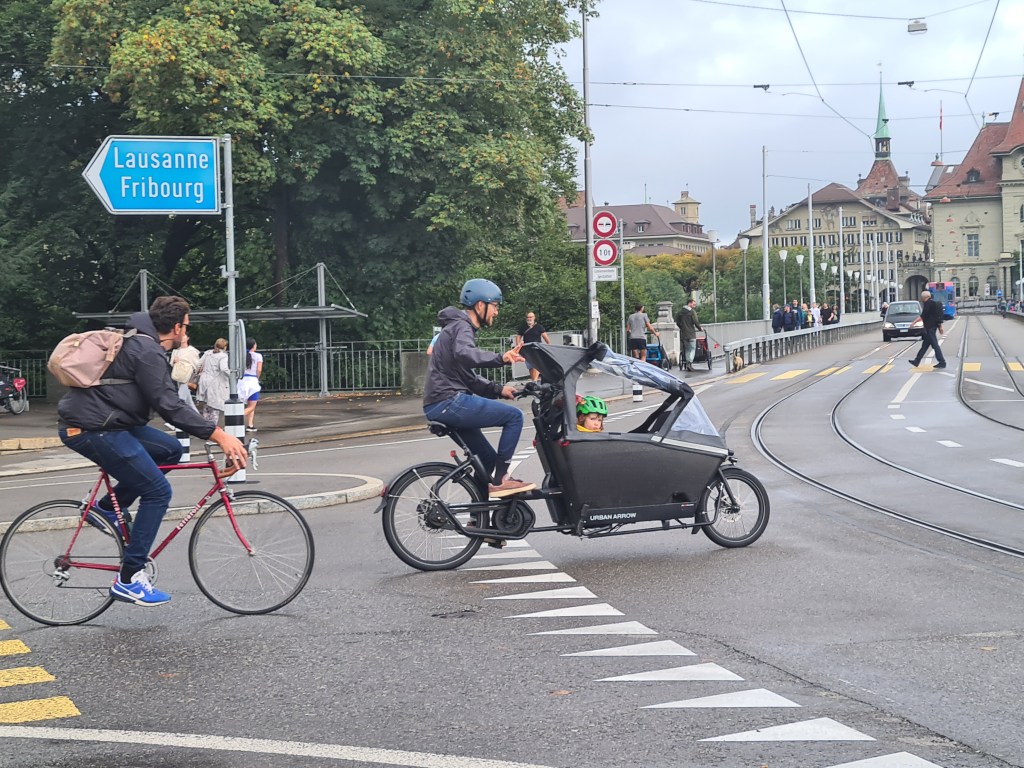
51. But it's definitely a city with a strong bike culture. When I ride down the street after a nine-year-old girl, and in front of her is a 70-year-old woman, and I pass parents on cargo bikes picking up the children from kindergarten, and women and men in business casual and suits zigzag between them, I know there is room for improvement, but that the situation is already pretty good.
52. And most importantly, it is clear that a lot of thought is put into any infrastructure planning and that there is a deep desire to make their city a better place to live. Michael and Stephanie are dealing with bikes, but I could hear how it was done from a holistic urban view, and it was really impressive. I really look forward to coming back here in the future and seeing how the city has improved.
 יצאתי לשאוף קצת רוח